
Last updated Friday, February 28, 2014
Click for an interview with Ray Kurzweil in The Wall Street Journal on Saturday, April 13, 2013. Although it is highly journalistic in nature, it covers all the major points, including the concept of Biological Escape Velocity .
September 10, 2007; At the Eagle Pub near Queens College, Cambridge; UK the proprietors have posted this commemorative plaque. Although Francis is no longer with us, our GRG Patron Saint, James Watson, is alive and well. His DNA was sequenced in June by Baylor University in Houston, TX using technology developed by 454 Life Sciences of Connecticut.
October 19, 2013; Prof. Richard Dawkins was recently interviewed in a short gratuitous Internet video-clip regarding the alleged " arrogance" or "selfishness" of seeking immortality while the Earth is increasingly overpopulated (TRT = 1:39 min.) without regard to consequences for our ecology. In defense of the contrary view, we must make clear that the rates of each tendency - - for increasing and decreasing statistical population numbers - - are not symmetric. I believe that we will need to do something to reduce the exponential birth rates in underdeveloped countries in the next century long before we need to worry about the fact that a comparatively few people might seek to indulge in radical life-extension technology and therefore won't die on schedule, thereby contributing somewhat to our human population explosion. With respect to absolute numbers by country, India and China will reach a cross-over point in a few years, in which India will become more populous than China. These demographics will not change for a long time whether experimental biogerontology achieves a solution to the problem of aging in our lifetimes or even in 500 years from now. In 500 years, all of these cautionary concerns will become moot. We will either achieve a steady-state sustainability or Homo sapiens will become extinct. - - LSC
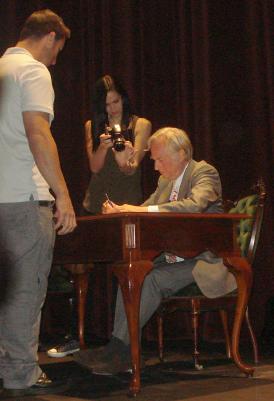
Sunday afternoon, October 20, 2013; [2:00 - 4:00] PM PDT; CalTech, Pasadena, CA; USA - -
Prof. Dawkins lectured for the Skeptics Society in Beckman Auditorium to a sold-out
audience of ~500 persons. Someone in the Q&A session asked him to clarify his position on the
desirability of radical life extension publicly. He replied, "I'd like to live for another 200 years or
so, but the prospect of being compelled to live for eternity is another matter altogether."
Presumably, he was thinking of the theological promise of Paradise or conversely the prospect of
an eternity in Hell. Of course, the counter argument is that, in the best of all possible worlds,
there would be no obligation to live forever, if one were to chose to self-terminate one's life,
assuming that we still had "free will." By the way, the name for such termination is called
euthanasia, but Prof. Dawkins choose not to pursue that line of reasoning in the time he
had available.
His discussion of "agency" was impeccable. Children learn very early in life by age two that the world is filled not only with physical objects possessing different properties (size, weight, shape, color, texture, taste, etc.) but also with autonomous agents (mother, father, siblings, strangers, etc.) each with different (sometimes antagonistic) agendas that may not be consistent with one's own purpose(s) (leading to conflict). Furthermore, the world may be a dangerous place. This leads to the problem of detecting threats and learning efficient ways to deal with them, while avoiding foolish Type-1 and Type-2 errors. Assuming that a hostile agent is around every corner may be a good idea or more likely a waste of time. Attributing all physical phenomena to agent(s) is a teleological fallacy, as first seen in pantheism with Egyptian gods or later Greek gods (Mount Olympus) and leads one to attributing the entire physical world to a creator/designer (without proof). Indeed, this may be a good strategy for one's short-term survival in the wild. Furthermore, since you know that you're important, any world designer must think so too and have provided you with a special role in that grand design (endowing you with "stewardship" for example). As an example, Dawkins said, "Imagine that the leaves are rustling behind you in the dark. Could it be a tiger (with his own agenda sneaking up on you) or was it merely the sound of the wind blowing through the trees?" Next, comes a potentially life-threatening critical decision that you must make and you must make instantly. Either (1) do nothing or (2) prepare to run as fast as you can! This explains the seduction of the "God Delusion" (that there must be a "super" agent with His/Her own personal agenda who might help you if you got in trouble and you prayed to Him/Her). But if it were the wind (a more likely hypothesis) there's no agency (teleological paradox) to deal with; it's a stochastic process without an intent to turn you into a delicous meal. Nevertheless, you ignore the sound of the leaves at your own peril and you better make sure that its was the wind.
Finally, when you die, you don't slip off to Heaven (or to Hell) as the traditional religious myth is perpetrated by our elders on our children (elders have there own agenda), but you simply cease to exist. The world continues (you're not a solipsist); it's just that you're not in it anymore. A computer (with an operating system -- when its up and running) doesn't go to "a computer heaven in the sky" when it's powered off (or thrown in the trash) for an "eternal rebooting." The world doesn't miss a beat when that machine is dead and gone. Dawkins called religious education the greatest of "sins" perpetrated by the establishment. Why should we teach a curriculum for which there is no evidence, as though it were sacred gospel? All of science is tentative, so why not the bible, which asks you to believe based on faith, not evidence? He said, "You should follow the instruction of your parents without the need for evidence at age six or less (e.g., "Don't pick up snakes"; and don't counter your mother, 'Well, I'm not sure I agree with you, I will have to take your no-snake-rule under advisement.'). However, after a certain age (say >12 yo), you need to rely on evidence-based critical-thinking despite what your parents, your family, your neighbors, your tribe, or your culture teach you. If you're already brain-washed by theological-indoctrination/dogmatic-ideology at a young age, it's much harder to break loose; you basically abandon your rational capacity -- your ability to hold assumptions tentatively without premature closure on a specific (but potentially wrong) hypothesis.
In Time Magazine ("10 Questions," p. 72; September 30, 2013), a reader asked "Given how little we know about the universe, how can we be so sure there is no God?" Dawkins answered, "There are all sorts of things we can't be sure of - - we can't be sure there are no leprechauns or fairies. Science in the future is going to be revealing all sorts of things of which we have no idea at present, but it's extremely unlikely that it would happen to home in on an idea from a Bronze-Age Tribe wandering in the desert."
So, I repeat... my opinion of Dawkins remains undiminished despite claims that he was anti- life-extension (he remains one of the most brilliant minds of our era and one of the top ten academic authors today). - - LSC
October 21, 2013; Click for another recent video from Prof. Dawkins on the theories of evolution. (TRT = 34:21 min.). - - LSC
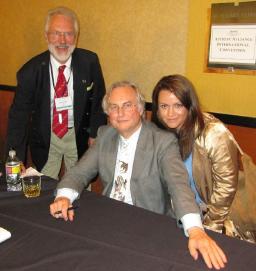
Saturday, October 3, 2009; 8:30 PM PDT; Burbank, CA - - Prof. Richard Dawkins on a book
tour for his newest book, The Greatest Show on Earth: The Evidence for Evolution used
PowerPoint slides - - and in his distinctive Oxfordian accent - - gave a reading of
excerpts from Chapter 13, "There Is Grandeur in this View of Life" to an audience of over
500 persons. This photo was taken during his book signing.
October 28, 2006; Prof. Richard Dawkins on a recent book tour of the US stopped at
CalTech in Pasadena on a warm and beautiful Saturday afternoon to do a series of readings from
his latest best-seller, The God Delusion to a standing-room-only audience in the
Beckman Auditorium. The photos below show him autographing copies of his book for those
who just bought one...


December 1, 2006; Click on the first photo above of the books to take a look at Prof. Dawkins new International Foundation for Science and Reason. His introductory video clip about the purposes of the Foundation is well worth watching.
"The universe as we observe it appears to have precisely the properties one would
expect if there were, at bottom, no design, no purpose, no evil, and no good, nothing but blind,
pitiless indifference."
"99.9 percent of all species that have ever lived on the Earth are now extinct. Any creatures,
including humans, that are still alive are the most recent version of a long line of true survivors."
-- Richard Dawkins, Fellow of New College and Charles Simonyi Professor of Public
Understanding of Science at Oxford University, UK

~10:00 PM PST; Good Friday, March 25, 2005, Crowne Plaza Hotel near LAX in Los Angeles,
California; USA
Professor Dawkins (L) is shown autographing a copy of his latest book, The Ancestor's Tale:
A Pilgrimage to the Dawn of Evolution (673 pages; Houghton Mifflin Company; Boston,
MA; 2004) for Stephen Coles following a one-hour lecture about a new book he is in the process
of writing on the topic of God's continuing role in human affairs. There will be an accompanying
TV documentary to be broadcast on UK Channel 4 sponsored by some sort of British
theological organization. And this despite the fact that Dawkins is a well-known atheist and will
not be ashamed to disclose this religious persuasion on TV. Ironically, we have referred to him
as our "Patron Saint," before we knew of this additional fact about him. After all, how can a
self-avowed atheist be the "saint" of anything?
One of the points that Dawkins made in his talk is that Darwinian evolution explains the existence of human beings without having to postulate a miraculous, irrational, magical, mysterious, supernatural force in the universe (i.e, God). It is elegant in the same way that prior ante-Greek models of the universe are inelegant. Consider the paradox of a flat-Earth plate being held up by four strong elephants. When asked what holds up the elephants? The perpetrators of this fairy tale, in the same equivalence class as the Easter Bunny and Santa Clause, asked us to imagine a really big turtle. By recursive induction, such a model becomes infinitely complex. You see what I mean. And this problem is not shared by the Copernican helico-centric round-earth model that contains its own mechanism ( gravity). Likewise the Darwinian principle of Survival of the Fittest coupled to a mutation rate in DNA in the context of a stochastic environment (an ecology of predator/prey relationships subject to thermodynamic entropy contains its own mechanism for extropy (the temporary elaboration of complexity given an ample supply of energy).
The introduction of Charles Darwin's Theory of Evolution followed by its elaboration by modern biologists, who have rationalized it in a manner to be consistent with the Laws of Physics and Chemistry, is spiritually liberating. And why is that? We no longer have to search out God's intent for mortal humans (Thy "will" be done on Earth as it is in Heaven.) which is such a frustrating business, since He has revealed so little evidence for His purpose, or having to listen to the admonitions of those self-appointed prophets who seek to speak for Him (the clergy/ruling-class, who fabricated the notions of sin and guilt, acting largely out of self-interest to maintain their social status). Instead, we can come to appreciate that our "human condition" is in no way sacred -- that it was, in fact, thrust upon us without our consent. Therefore, we can change it if it suits our own purpose, in the same fashion as wearing clothing when it's cold or putting on a pair of spectacles when our vision becomes impaired with old age without fear of untoward consequences in the "afterlife." So, this argument is liberating in the sense that the fatalistic dogma of nearly all religions regarding "heaven" (and "hell") and/or reincarnation can now be ignored with impunity.
This doesn't mean that we can safely abandon our sense of moral purpose while we are here on this planet. We know that we have free will, but there are consequences for our actions. It does mean that we have a shared responsibility to create a social system of morality, ethics, and laws while we are here to facilitate our free search for ultimate purpose in our lives. And this is one of the central purposes of religion, among which are attempts at explanation of the mysteries of nature, rituals for the celebration of critical-path life-history events (birth, adulthood, marriage, and death), and inspiration to find value in our lives.
"There is a natural equilibrium between the extinction of old species and the evolution
of new species (speciation) which is delicately balanced by the rate of mutations
introduced into DNA during replication." This is, of course, the result of a seemingly-deliberate
intrinsic net error rate in the germ-line cells following post-replicative enzymatic proof-reading
or post-editing of the DNA (not too much, but not too little either, about 1 per billion nucleotides
in mammals) and, in particular, the evolution of sperm/egg surface-antigenic hand-shakes to
complete the process of speciation. The Darwinian invention of diploid chromosomal
crossing-over during sexual reproduction accelerated the rate of speciation considerably
and gave a significant advantage to both plants and animals who adopted this mode of
reproduction on the surface of the earth (or in the shallow areas of the oceans) in coping with
periodic mass extinctions which broke the food chain during rare periods of multi-season
darkness (punctuated evolution). This advantage obtains from having a stockpile of recessive
genes in the pool when the environment changes capriciously disfavoring the corresponding
dominant genes This would certainly not be a fun time for large predatory animals, who before
this event, enjoyed being located toward the top of the food web.
"Extinction" PBS-TV Series on Evolution Part 4 of 7 (Channel 28; Friday, May 24,
2002; 11:00 PM PDT; TRT= 1 hour)
"When Earth's human population passed 6 billion, we had already exceeded by as much
as 100 times the biomass of any large animal species that had ever existed on land." We
consume and exhale materials in such large amounts that we have already modified the air, the
water, and the land we inhabit. At the rate we're going, by the end of the present Century, we
may have extinguished half the species of plants and animals that have ever lived on Earth. We
take small comfort in the idea that extinction only happens to big scary dinosaurs or tiny
insignificant fish --- not in our own backyards. But the truth is that, in the event of a non-linear
catastrophic event in our biosphere, we could be in serious danger of extinguishing not only our
own species but almost every other form of life along with us. If, as a species, humans continue
to depend on the fragile earth-surface food chain, there is no guarantee that we can escape from
this predicament of extinction. Those who wish to forever avoid the fate of the dinosaurs have
some work to do.
--- Professor Edward Osborne Wilson, Biology Department, Harvard University
Ref. The Future of Life (Knopf, New York; 2002).
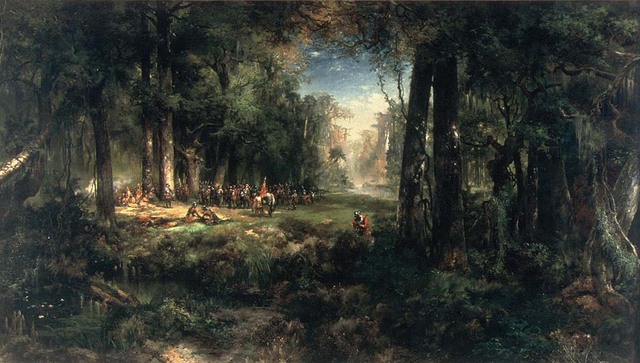
Painting by Thomas Moran, "Ponce de Leon in Florida" looking in vain for the Fountain of
Youth .)
There were
to the Charter Section of our website.
Click on the icon above for more details.