
Dateline: 449.05.08 AG <After Galileo [*]>[Thursday, May 8, 2014]
THE REVISED
BOOK OF GENESIS
by
L. Stephen Coles, M.D., Ph.D., Co-Founder and Executive Director
Los Angeles Gerontology Research Group
Los Angeles, California; USA
E-mail: scoles@grg.org .
Chapter 1
1. In the beginning, there was a bang. And it was a big bang** --- one that was filled with implications for all that would follow. The first consequence was time [60]; the second was space.
__________________________________
** However one may feel uncomfortable with the notion undertaking a substantial revision to
this revision after only four short years of being posted on this website, it is especially annoying
to be confronted with the prospect of having to revise Verse 1 of Chapter 1 on
the grounds that it may actually be wrong! But anyway, here goes: The concept of a "big bang,"
although temptingly elegant, may itself be a vast oversimplification. There is no evidence that
there ever was an expanding three-dimensional spherical shockwave of stars exploding away
from a single point of origin in which the expansion gradually slows down, as the initial kinetic
energy of the explosion dissipates. Indeed, it may have been better to start out with, " In the
beginning, there was a singular event..." It may be more consistent with emerging
cosmological data to call this an event that triggered an "avalanche on a snow-packed mountain
on a dark and moonless night" in which we are part of the snow tumbling down a mysterious
grade whose dimensions are still unknown to us. Speaking metaphorically, the galaxies of stars
may be like a luminous fog that precipitated out of the darkness and is sinking into a dark box
canyon whose shape may be either smooth or sharp, and we're not sure which, resulting in
extremely turbulent edge effects. The fog may not even be falling but rather simply expanding
through a lattice of holes (a syncytium of connected holes in a giant block of Swiss cheese)
whose dimensions are virtually unknowable from our present vantage point. The presence of a
"dark mountain" may correspond to the so-called " dark matter" (90 percent of the
calculated mass or eight times that of visible matter) that is causing the expansion to accelerate
through its own gravitational influence. Anyway, the luminous part of the universe may soon be
extinguished as the wispy strands of galaxies where stars are born are further disbursed and
collectively run out of fuel to keep their fires burning. The visible universe may bear the same
relationship to the non-visible universe as foam on the crests of the waves does to the
ocean, as waves relentlessly crash on the beach. At night, walking along the seashore,
one can see the foam without being able to distinguish the dark sky from the dark ocean, but we
know they're there, since we can easily see the difference in the day time.
December 4,2012; For perspective, here is a Quick Chronology of 12 Important Dates:
Event Time
1. Big Bang 13.82 BYA [1]
2. Milky Way Galaxy 10.2 BYA [2]
3. Our Sun Illuminates 4.6 BYA [3]
4. Earth and Moon Formed 4.5 BYA [4]
5. Life Begins on Earth {RNA} 3.8 BYA
6. Tool-Using Hominids Cook Food with Fire 500 KYA [5]
7. H. Sapiens 200 KYA
8. Agriculture/Irrigation 10 KYA
9. Writing 3.6 KYA
10. Logic/Mathematics 300 BCE
11. Structure of DNA 60 years ago
12. ARPANet/Internet 40 years ago
Local References:
1. Between [80 and 100] Million Years have been added to the age of the universe in 2013 due to
recent data revealed by the European Space Agency's Planck Satellite.
2. 95 percent of all stars that will ever shine have already come and gone.
The rate of new star formation has actually declined substantially since the early days of the
universe, which is not well appreciated.
3. The fact that first-generation stars didn't have any heavy elements near by, but produce them
after they supernova means that second-generation (or more) stars, like our Sun, had an
opportunity to produce rocky planets around their disk. These are essential for molecular life (as
we know it). As far as the evolutionary history of the solar system is concerned, the Sun was at
the center of a dirty disk in which four rocky planets (including Earth) and four gasseous planets
formed (Pluto [now called a dwarf or minor planet] with its four moons was subsequently
excluded from the eight planets and is now included amongst a large group of Kuiper Belt
Objects [30 - 50] au's from the Sun). The English language contains words for particles of
differing granularity: powder (fluidic), dust, grains (of sand at the beach), gravel, pebbles, stones,
rocks, boulders, meteoroids/asteroids, moons, planetismals (there were once 100's of these),
planetoids, and lastly planets (now with the downgrading of Pluto and the failure of the asteroid
belt to form a true planet due to Jovian gravity that blocked the alignment of individual units, we
are down to eight).
4. The Sun will slowly get hotter and bigger (bigger than the orbit of Mercury), as it exhausts its
supply of hydrogen fuel, moving to become a red giant and later reach the terminal stage of a
very dense "white dwarf." Some stars will explode in a massive supernova, if they initially were
large enough to start with. But all stars will suffer the same fate, no matter where they are in the
universe. Freeman Dyson of the Institute for Advanced Studies in Princeton has suggested that
the way that human life could continue beyond the death of the last stars would be to extract
energy from black holes, but new data about Dark Energy and the accelerating expansion of the
universe makes that tactic questionable. If the expansion of the universe continues without limit,
our future will become truly dark. Galaxies will disappear from view forever. Only our local
Milky Way stars will be visible in the night sky until they too twinkle out of sight. That will be
followed by a "big rip" in which the energy content of all protons, neutrons, and electrons will
evaporate into the darkness of space.
The presence of our Moon [Luna] influenced the development of life on the Earth considerably.
For example, it not only modulated oceanic tides, it stabilized the angle of declination (~22-1/2
degrees; modulo precession of the sort that you see with a spinning top) without which we would
have had extreme climate variation (from no seasons {Fall, Winter, Spring, and Summer} at zero
degrees to two seasons [which might be called Worse {hot} and Worst
{freezing}] every six months at 90 degrees). This would have been extremely inhospitable to the
formation of life as we know it.
Even with the presence of our Moon, life on Earth was nearly obliterated on 20 separate
occasions. It is speculated that this may have been due to the sinusoidal trajectory of our solar
system as it bobs up and down through the plane of the galaxy as it slowly rotates about its
central black hole (period = 200 million years. Passage through the central disk from above to
below and back may be dangerous to life.
Of course, there continue to be random astronomical events, like massive comets or asteroids that
smash into the Earth periodically, one of which occurred 70 MYA that trigger punctuated
evolution causing sharp changes in temperature, opacity of the atmosphere due to dust, or alter its
composition (percent oxygen, nitrogen, and carbon dioxide). Many species die off because they
can't adapt to abrupt changes in the environment, while others may flourish under these same
circumstances. For example, If there was too much water from asteroids, land continents would
never have emerged, and we wold have become a watery planet where he highest predator might
have been a shark (eating machines and that's all).
5. Sharpened stone points were used on the tips of throwing spears for hunting 200K years
earlier than previously thought ( Science, Cape Town, South Africa; NYT, p.
D3, (Novrmberf 20, 2012)).
January 16, 2012; According to the latest thinking by astronomers, 73 percent of the universe may be "dark energy" intrinsic in each cubic volume of space [B52]. There many be 4 percent visible matter and 23 percent dark matter to make up the rest. As this stochastic, quantum energy boils up, this could explain the observation that the expansion of the outermost galactic clusters is accelerating, not slowing down. [Nobel Prize in Physics for 2011] So according to this model, the dark matter along the cosmic web derived from the Big Bang takes the form of strands of invisible scaffolding for the visible matter that we can see (galaxies). This is consistent with the observation that dark matter appears to be most dense around each galaxy in the form of a halo. Another recent observation by cosmologists is that there appears to have been a cross-over ~5 BYA (Billion Years Ago) between the gravitational force of dark matter which would ultimately cause the universe to slow its expansion originating with the Big Bang and then cause it to collapse and the expansionary force of dark energy which is now dominant over the force of dark matter.
November 26, 2012; The gravitational force of dark matter appears to be responsible for the spider-web scaffolding shown in diagrams below. The location of the dark matter is unknown, but it may be embedded in higher dimensions beyond the three spacial dimensions that we know and love. Galaxies of visible matter/energy seem to have formed at the intersections of the "dark webbing." Dark energy appears to be responsible for the acceleration of the galaxies away from each other and therefore must be stretching the web apart. The location of dark energy is also unknown. It may not be outside the visible universe, but a property of empty space itself which increases its volume continuously! We must go down toward the Plank Length at 10 -35 m to figure out what's going on with what seems to be empty space but may not be really empty. Cosmologists have a long way to go before we converge on a true Theory of Everything (ToE).
Prof. Kip Thorne, in his book Black Holes and Time Warps [B35], wrote,
"Throughout this book, I shall adopt, without apology, the view that there does exist an ultimate
set of physical laws [or standard model] (which we do not as yet know, but which might be
called quantum gravity [sometimes referred to as the "Theory of Everything (ToE)," a
phrase now favored by string theorists]), and that those laws truly do govern the universe around
us, everywhere [and for all time in a coordinate-system independent manner]. These laws force
[or cause] the universe to behave in the way it does."
This standard model must embrace not only the here-and-now of particle physics and astronomy
but also provide a consistent cosmological explanation for the origin of everything we see and
can deduce from the scientific data acquired by our various telescopes and other instruments.
After the Big Bang, symmetry-breaking must have occurred at some point in order to explain the
large production of matter over antimatter, the mass difference between the Proton and the
Neutron, a short-range rather than a long-range Weak Force, and generally, particles with non-
zero mass [like the Neutrino]. In recent years, it has become fashionable to speak of the different
physical parameters of the universe as if they were preselected to lead to the evolution of life on
Earth. The fact that life as we know it depends on the exact values of these parameters, "fine-
tuned" to high precision, is regarded as evidence that the universe was designed with that
purpose in mind. Philosophers term this notion the Anthropic Principle (AP) which
posits that a model of our universe that does not allow for the existence of life as we know it
cannot possibly be valid. {Proof by contradiction.} Nevertheless, all the parameters in our
standard model that can be determined by experiment are believed to be derivable from some
minimum set of principles. It seems highly unlikely that any purely natural set of principles
would be intimately connected to the biological systems that happen to have evolved on our
particular planet. A more likely scenario is that life evolved in response to a particular set of
physical parameters as an emergent property. If the symmetry-breaking in the early universe was
in fact spontaneous, i.e., not subject to any underlying recursive mechanism, then the values of at
least some of the parameters would be accidental. In other words, if we had an ensemble of
universes (a "Multiverse," if you will) then the parameter values necessary for life to evolve as an
emergent property had to arise from a random distribution without the requirement for an
external, causal, designing agent [God] designating one particular preferred set. Indeed, there is
no evidence toward the existence of God in the religious sense whatsoever. Life in our
observable part of the universe looks just as it should look if it were randomly created and not
designed with a particular intent. It looks and operates according to natural laws just as it should
it were to appear spontaneously. [A36] One of the ironic corollaries of this ensemble of
universes or Multiverse concept is that the number of universes in which we could be
there to wearily ponder our human condition might be relatively sparse, with a vast, vast number
of dark and cold universes surrounding us, but incapable of sustaining life as we know it.
[B36]
January 8, 2007; Hubble Space Telescope images have now helped us chart the structure and
location of dark matter. This material appears to be like a "construction scaffold on the outside
of a building," allowing visible matter to precipitate galaxies on the scaffold surrounding it.
Therefore, both forms of matter (visible and dark) are found contiguously in empty space.
Furthermore, the map has demonstrated that the structure of dark matter has altered over billions
of years from a smoother configuration to a rather lumpy or "filamentous" structure as it
collapses on its own gravity. Dark matter and energy (96 percent of the universe) can also
explain why the universe is continuing to expand. [***] Without them, the universe, as we
observe it, may already have collapsed secondary to its own internal gravity - - The Big
Crunch. [B38]
Before going on, we ought to remind the reader of the various historical misconceptions that
afflicted the proponents of early myths about the origin of our universe...
The oldest ancients believed that all planets were simply wandering (non-twinkling) stars.
But once humans caught on to the idea that planets were somehow different than stars (the light
is reflected) and that (twinkling) stars were somehow much further away, the Sun was at that
time considered to be a planet and not a star! Indeed, this form of cosmology held sway from the
time of Aristotle [~300 BCE], who is credited as the first philosopher to attempt to combine a
knowledge of earthbound physics with celestial motions. Our local dynamics [laws of motion]
and mechanics operated on four earthly elements {earth, air, water, and fire}. Quintessential
matter, however, was a fifth type of element comprising so-called aether objects. These
could move "sideways" in circular [but not elliptical] orbits. Therefore, aether objects didn't
have to obey the laws of normal matter, like either "up" (fire and air) or "down" (water and rocks)
with respect to the ground. At this point, before the invention of optics (telescopes and
microscopes), we were limited to seven "planets" (visible with the naked eye). (Naively, the Sun
and the Moon were included in this list of planets, even though we now know that neither is a
planet.)
In pre-Copernican times, the Earth was considered to be the center of the Universe; now it known
to be just another planet in orbit around the Sun. Neither is our own star pre-eminently at the
"center" of the universe, nor, for that matter, is our Milky Way Galaxy at the center (sadly,
professional Astrologers and professional Astronomers were not distinguished in those early
days).
Galileo used his telescope to locate Sun spots, moving on the surface of the Sun that clearly
demonstrated its "imperfections." But when you were taught from childhood, that God lives in
the Heavens and therefore all celestial objects are perfect like Him, it's hard to break from this
central dogma as an adult. Perhaps that's why clerics of the Roman Catholic Church declined to
look through the telescope when Galileo invited them to do so, lest they experience cognitive
dissonance and be forced to question their faith.
Most recently, our former 9th planet, Pluto, ~70 years after its discovery, was unceremoniously
demoted to the status of a minor planet or more technically, a Kuiper Belt Object (KBO).
Another KBO named Eris (formerly Xena) with a moon named
Dsynomia was recently discovered by Prof. Michael Brown of UC Berkeley to be 27 percent
more massive than Pluto. Pluto, by the way, is now known to have two more moons (tentatively
named S2005 P1 and P2, likely to be named Hydra and Nix,
respectively [In Greek mythology, Nyx was a goddess of the night and Mother of the
boatman, Charon]), in addition to its larger moon Charon.
From all of these fundamental misconceptions, the one thing that we can learn from the flawed
history of science pertaining to astronomy is that the solar system that we live in turns out to be
quite different than the one that our ancestors thought we lived in. Thus, as a corollary, all future
cosmological hypotheses should be held as tentative and not absolute. [B37]
Note: The singleton Big Bang hypothesis (with inflation/multiverse variations to explain a few
anomalies or objections) is now being challenged fundamentally by a couple of "Brane
Theorists" who present convincing arguments in support of an endlessly oscillating universe (of
periodic big-bangs/big-crunches when two mem'branes', under tension, come into contact and
are suddenly "kicked back" with a calculated period of about one trillion years in a
10-dimensional space. The hidden dimensions [4-10] are invisible to the human eye, but are
essential to make the math work) [B39].
_______________
*** November 30, 2011; The universe ranges from the smallest known particles to the entire
bubble, from 10 - 35 meters (the Planck Radius, where quantum gravity rules)
to 10 27 meters (the entire visible universe, 100 billion light-years across, where
dark matter and dark energy dominate), a stunning 62 orders of magnitude. Randall correctly
notes the age of the universe at 13.75 billion years, clarifying her apparently paradoxical figure of
100 billion light-years. - - The explanation for why the universe as a whole is bigger than the
distance a signal could have traveled, given its age, is that space itself is expanding [self
replicating?], causing a "big push" (paradoxically due to the dark energy of seemingly empty
space which is buzzing with activity at the quantum level) and not that dark matter is causing a
gravitational "big pull," a pull from elsewhere beyond the visible universe, which is causing the
universe to expand at an accelerating pace [B40].
This is really a difficult concept to
get one's mind around and nothing that one would attempt to teach one's children in a fairy tale,
so that they would stop asking fundamental questions that would embarrass their adult parents by
exposing their ignorance as profound and deep.
February 28, 2012; In their book The Quantum Universe [B53], Cox and Forshaw
explain that even some physicists reel from the implication that nature is irreducibly random as
first proposed by Werner Heisenberg in 1925 at the age of 23. Indeed, Albert Einstein spent the
latter part of his life searching in vain for a more palatable theory ("God does not play dice with
the universe.") Yet we now have an appreciation that every bit of matter in the universe (visible
matter and dark matter [83 percent]) is composed of an arrangement of four elementary particles:
two quarks, an electron, and a neutrino. The Higgs Boson and the Higgs Field (that gives all
matter its mass) are waiting in the wings, so to speak. The presence of dark matter is why the
Andromeda Galaxy (Nebula) and our own Milky Way Galaxy in our Local Cluster will
ultimately collide in 3 to 5 billion years. It is the dark matter that causes local turbulence in the
condensation of matter along the expanding shock wave from the Big Bang. Furthermore, dark
matter and dark energy are mutually antagonistic with the matter using gravity to try and pull the
universe back to a single point, while dark energy (in an apparently empty vacuum) is responsible
for the accelerating expansion of the universe. Clearly, the force of dark energy is stronger than
the force of gravity, ultimately leading us away from a "big crunch" and toward a quiet, still
darkness. So, as T. S. Elliot said, the world will end not with a bang but with a whimper.
March 14, 2012; Regarding the standard model of physics, 50 years ago physicists thought that
the visible universe galaxies, stars, planets, comets, asteroids, and so on was made up of
atoms and atoms were thought to be composed in turn of protons, electrons, and neutrons
leading to to the Periodic Table of the Elements [as distinguished from the Greek simplification
quartet of of {air, water, fire, and earth}]. We now know that this atom-based universe was a
fabulous over simplification. Atoms make up only four percent of the universe! The other 96
percent is made up of "dark matter" (73 percent) and "dark energy" (23 percent), neither of
which we know very much about. Indeed protons (and neutrons by extension) are composed of
trios of other particles romantically called quarks, which come in a zoo of weird types,
the most famous of which has been called The Higgs Boson (or the "God Particle"),
whose discovery CERN physicists announced in Geneva, SWITZERLAND on July 4, 2012 [56].
The LHC (Large Hadron Collider) has now identified this elusive particle. Its presence was
confirmed at a second location in the USA (Fermi Labs). The difference between dark energy in
the universe as suggested by the observed rate of expansion of the galaxies from the time of the
big bang and the amount required by current theory is off by a mind-blowing 10|120th power!
This is as embarrassing for a physicist as it can get. The world slowly reveals itself to science to
be more complex than we could ever have imagined when we were Greeks for whom the four
elements were sufficient to explain the world very well thank you (BTW, none of the four Greek
elements have actually turned out to be elements by today's standard model of inorganic
chemistry; they are all compounds and/or mixtures of other "stuff").
August 26, 2012; Our understanding of the architecture of the universe is becoming increasingly sophisticated and ranges from planets to stars to galaxies. But our galaxy, the Milky Way is part of a Verge Cluster, which is part of a Local Cluster, which is part of a Shapley Supercluster, which is part of a Lyman Alpha Blob, all of which are embedded in the overall Cosmic Web with blobs connected by strands. See below.
January 20, 2014; Galaxies are likely connected by a cosmic web of fibers [62] now based on a distant quasar in the nebula Cyan extending across 2 million light-years that was discovered around the bright quasar UM287. The energetic radiation of the quasar makes the surrounding intergalactic gas glow, revealing the morphology and physical properties of a cosmic web filament. The image was obtained at the W. M. Keck Observatory. Astronomers have discovered a distant quasar illuminating a vast nebula of diffuse gas, revealing, for the first time, part of the network of filaments thought to connect galaxies in a cosmic web. Researchers at the University of California, Santa Cruz (UC Santa Cruz) led the study, published in Nature.
Using the 10-m Keck I Telescope at the W. M. Keck Observatory in Hawaii, the researchers detected a very large, luminous nebula of gas extending about two million light-years across intergalactic space. "This is a very exceptional object: It's huge, at least twice as large as any nebula detected before, and it extends well beyond the galactic environment of the quasar," said first author Sebastiano Cantalupo, a postdoctoral fellow at UC Santa Cruz.
The standard cosmological model of structure formation in the universe predicts that galaxies are embedded in a cosmic web of matter, most of which (about 84 percent) is invisible "dark matter." This web is seen in the results from computer simulations of the evolution of structure in the universe, which show the distribution of dark matter on large scales, including the dark matter "halos" in which galaxies form and the cosmic web of filaments that connect them. Gravity causes ordinary matter to follow the distribution of dark matter, so filaments of diffuse, ionized gas are expected to trace a pattern similar to that seen in dark matter simulations.
Until now, however, these filaments have never been seen. Intergalactic gas has been detected by its absorption of light from bright background sources, but those results don't reveal how the gas is distributed. In this study, the researchers detected the fluorescent glow of hydrogen gas resulting from its illumination by intense radiation from the quasar.
"This quasar is illuminating diffuse gas on scales well beyond any we've seen before, giving us the first picture of extended gas between galaxies. It provides a terrific insight into the overall structure of our universe," said coauthor J. Xavier Prochaska, Prof. of Astronomy and Astrophysics at UC Santa Cruz.
The hydrogen gas illuminated by the quasar emits ultraviolet light known as "Lyman Alpha Radiation." The distance to the quasar is so great (about 10 billion light-years) that the emitted light is "stretched" by the expansion of the universe from an invisible ultraviolet wavelength to a visible shade of violet by the time it reaches the Keck Telescope. Knowing the distance to the quasar, the researchers calculated the wavelength for Lyman Alpha Radiation from that distance and built a special filter for the telescope's LRIS spectrometer to get an image at that wavelength.
"We have studied other quasars this way without detecting such extended gas," Cantalupo said. "The light from the quasar is like a flashlight beam, and in this case we were lucky that the flashlight is pointing toward the nebula and making the gas glow. We think this is part of a filament that may be even more extended than this, but we only see the part of the filament that is illuminated by the beamed emission from the quasar."
A quasar is a type of active galactic nucleus that emits intense radiation powered by a supermassive black hole at the center of the galaxy. In an earlier survey of distant quasars using the same technique to look for glowing gas, Cantalupo and others detected so-called "dark galaxies," the densest knots gas in the cosmic web. These dark galaxies are thought to be either too small or too young to have formed stars. "The dark galaxies are much denser and smaller parts of the cosmic web. In this new image, we also see dark galaxies, in addition to the much more diffuse and extended nebula," Cantalupo said. "Some of this gas will fall into galaxies, but most of it will remain diffuse and never form stars." The researchers estimated the amount of gas in the nebula to be at least 10x more than expected from the results of computer simulations. "We think there may be more gas contained in small dense clumps within the cosmic web than is seen in our models. These observations are challenging our understanding of intergalactic gas and giving us a new laboratory to test and refine our models," Cantalupo said.
Illustris employs a sophisticated computer program to recreate the evolution of the universe in high fidelity. It includes both normal matter and dark matter using 12 billion 3-D pixels (resolution elements).
May 7, 2014; (R&D) -- Astronomers have created the first realistic virtual universe using a computer simulation called "Illustris." Illustris can recreate 13 billion years of cosmic evolution in a cube 350 million light-years on a side with unprecedented resolution. "Until now, no single simulation was able to reproduce the universe on both large and small scales simultaneously," says lead author Mark Vogelsberger (MIT/Harvard-Smithsonian Center for Astrophysics), who conducted the work in collaboration with researchers at several institutions, including the Heidelberg Institute for Theoretical Studies in Germany. These results are being reported in the May 8, 2014 issue of the journal Nature.
Previous attempts to simulate the universe were hampered by lack of computing power and the complexities of the underlying physics. As a result those programs either were limited in resolution, or forced to focus on a small portion of the universe. Earlier simulations also had trouble modeling complex feedback from star formation, supernova explosions, and supermassive black holes.
Illustris employs a sophisticated computer program to recreate the evolution of the universe in high fidelity. It includes both normal matter and dark matter using 12 billion 3-D "pixels," or resolution elements. The team dedicated five years to developing the Illustris Program. The actual calculations took three months of "run time," using a total of 8,000 CPU's running in parallel. If they had used an average desktop computer, the calculations would have taken more than 2,000 years to complete.
The computer simulation began a mere 12 million years after the Big Bang. When it reached the present day, astronomers counted more than 41,000 galaxies in the cube of simulated space. Importantly, Illustris yielded a realistic mix of spiral galaxies like the Milky Way and football-shaped elliptical [spheroidal] galaxies. It also recreated large- scale structures like galaxy clusters and the bubbles and voids of the cosmic web. On the small scale, it accurately recreated the chemistries of individual galaxies.
Since light travels at a fixed speed, the farther away astronomers look, the farther back in time they can see. A galaxy one billion light-years away is seen as it was a billion years ago. Telescopes like Hubble can give us views of the early universe by looking to greater distances. However, astronomers can't use Hubble to follow the evolution of a single galaxy over time. Illustris is like a time machine. We can go forward and backward in time. We can pause the simulation and zoom into a single galaxy or galaxy cluster to see what's really going on," says co-author Shy Genel of the CfA.
The team is releasing a high-definition video, which morphs between different components of the simulation to highlight various layers (e.g., dark matter density, gas temperature, or chemistry). They also are releasing several smaller videos and associated imagery on-line at illustris- project. (TRT = 6:44 min.)
Source: Harvard-Smithsonian Center for Astrophysics
2. Time began ticking forward at time "zero" from this initial moment (in constant intervals). The arrow of time is unidirectional, always forward, never backward (despite a vast array of stories to the contrary, authored by clever science-fiction script-writers who systematically exploit the time-travel-machine fallacy, because it's so inexpensive to represent this Star Trek foolishness on film by merely dressing up the characters in old- fashioned clothing, or whatever).
Corollary: Following the normal convention, we may partition our temporal dimension into three parts: The past, the present, and the future. All natural languages makes provision for verb inflection that grammarians refer to as tense. From the perspective of an individual lifetime, one person's perspective is like a laser-pointer illuminating a gigantic, dark ruler of time. We live in the light of the present as it systematically creeps forward. Everything 10,000 years before the pointer (the beginning of recorded history) is shrouded in the darkness of our unknowable, dead past, except, to some extent, for the work of anthropologists (striving to decipher our ancestors' thoughts), paleontologists, geologists, and astronomers (cosmologists). Everything forward of the pointer is covered by the darkness of an unknowable future. Thus, we are extraordinarily lucky to find ourselves within this light at all (the light of the present), given the vast dark expanse of the temporal ruler. [B39; p. 361]
Dr. Sean Carroll of CalTech in Pasadena, CA [B41] believes that he has a solution to the
enigma of why time is unidirectional (a surrogate for the relentless increase in entropy described
in the Second Law of Thermodynamics [as measured by the formula
s = K logW where
s is entropy;
K is the Boltzman Constant; and
W is the number of possible rearrangements of units in the universe]).
In a larger multiverse in which multiple universes (of which ours is only one) are active
concurrently, some of them have time (entropy) moving in one direction while others have
their time moving in the opposite direction. Thus, the net temporal (entropic) displacement is
zero. (BTW, this does not introduce the fantasy-option of time travel because all these
discussions are statistical in nature. One can never turn "an omelet into an egg" in the real world;
only using the reverse button in a video can one create such an illusion of decreasing entropy in
an intentional manner without doing any work). Multiple 'children universes' are spawned
(budded) from a single 'mother universe' in which time is stationary, since this universe's
entropy is as high as it can ever be. A new universe, with its own big bang, can then bud off
randomly from the mother universe due to statistical fluctuations in quantum gravity and dark
energy. By the way, the First Law of Thermodynamics (conservation of matter/energy)
is not valid for the universe as a whole, since it's not a closed system. Indeed, new space is being
injected uniformly from some invisible higher spacial dimension (resulting in an expansion,
indeed an accelerating expansion, of the distance between certain galactic clusters). Furthermore,
each cubic centimeter of new space that gets added with time comes with its own vacuum energy
(dark energy). Although it's a small amount per cc, when summed together, it represents a rather
large amount of energy, sufficient to warp space in strange ways and substantially change the
nature of the universe in the future. See Dr. Carroll's personal website at
cosmicvariance.com for more details.
Schrodinger's cat makes a cameo appearance in a You Tube video clip of 30,000
colorful dominos that all fall down with the help of a single gentle push.
An alternative Loop Quantum Gravity explanation based on an oscillating universe (successive big bangs and big crunches) can be found in [B42], but the evidence for this concept is slim. It looks like our own universe will never crunch. Instead, it is destined to wind up billions of years in the future as an extremely high entropy level, very cold and uniformly dark, uninhabitable place.
3. The approximate time-of-origin of the Big Bang, as reckoned in our Earth years, was
13.75 (+/- 0.11) BYA (Billion Years Ago) (by definition, one Hubble Time). [For
reference the age of the Earth is estimated to be 4.54 BYA and the origin of Life on the Earth is
esttimated to be 3.50 BYA.] The background of the estimate of the age of the universe is as
follows: Over the last decade astronomers have calculated the age of the universe as ranging
from [8 - 20] billion years by using different methods. This latest estimate comes from an
analysis of 3,000 recently discovered quasars, allowing astronomers to map with
unprecedented precision the distribution of diffuse gas between the galaxies. See
Uros Seljak of Princeton University
and HREF="http://xxx.lanl.gov/abs/astro-ph/0407327">.NASA satellite "glow" study
(Ronald Cowen, "Universal Truths: Distant Quasars Reveal Content, Age of Universe,"
Science News, Vol. 166, No. 5, pp. 69-70, July 31, 2004). Another recent estimate is based
on The Wilkinson Microwave Anisotropy Probe (WMAP) Mission that looked back in
time to just 380,000 years after the big bang, according to NASA researchers on February 11,
2003. Other recent observations were made by the Hubble Space Telescope using three random
galaxies at the outer fringe of the visible universe with an average age of 12.6 billion years (per
standard red shift calculations). Recently, Harvey Richer of the University of British Columbia
and Wendy Freedman of the Carnegie Observatories in Pasadena, California have pushed the
Hubble Space Telescope's vision to its limit by looking at some of the Milky Way's least
luminous white dwarfs members of stars that depleted their fuel a long time ago. They found an
ancient white dwarf inside a globular star cluster 7,000 light-years away, one-billionth as bright
as the faintest stars visible to the naked eye. It took eight consecutive days of exposure for the
Hubble cameras to detect this dim white dwarf. These stars start off hot, but then cool down in a
highly predictable manner. The coolest, dimmest dwarfs observed by Hubble are the oldest.
Richer and his team calculated that these stars are [12 - 13] billion years old. Of course, one must
take into consideration that about one billion years elapsed from the time of the Big Bang before
light appeared in the otherwise dark infant universe, hence the final number for one Hubble Time
is one billion years more. The findings were announced in Washington, D.C. on April 24, 2002
and are slated for publication in the next issue of Astrophysical Journal Letters.
A team of Swiss and French astronomers reported on March 6, 2004 that they had found the most
distant galaxy yet ( Abell 1835 IR1916), 13.23 billion light years from Earth, and was
first formed when the universe was approximately 750 million years old. This puts our estimate
of the age of the universe in very close correspondence with actual observation.
The Astronomy Education Board of the American Astronomical Society (AAS) has prepared an article for teachers and students (K-12) on how astronomers know that the universe is so old and how it has changed with time. This article has now been posted on the Internet at The Universe in the Classroom.
During the fist second after the Big Bang, 13.7 BYA (Billion Years Ago), there was extraordinary activity taking place. At 10-43 seconds Quantum Gravity ended. While at 10-35 seconds the electro-weak and strong nuclear forces, once united, divided. Protons and neutrons did not form until a long microsecond later, 10-6. The term inflation is used to describe an enormous growth spurt immediately after the start of the big bang. The infant cosmos ballooned from one-billionth of a trillionth of a hydrogen atom's diameter to that of a soccer ball within just 10-35 seconds. Curiously, all this activity took place in darkness, since the first stars (with photons) did not appear until 300 million years after the big bang. Clusters of galaxies didn't form until 700 million years post big bang.
August 12, 2011; In a final remark about time, Dr. Stephen Hawking of Cambridge University has observed that it makes no sense to ask what happened before the Big Bang, since time itself slows and comes to a halt as one approaches the event horizon of any black hole and the event horizon of the big bang by extension must have been identical in how it treats the constant ticking forward of linear time, once hyperinflation was over a few minutes later. Therefore, t = 0 at the start of the big bang, and there is no negative time before t = 0 by definition of the laws of physics; there would have been no clocks to measure it, and even if there were, they would not be ticking before hand, and there is no "worm hole" escape from our universe to get outside of it to time it. Hawking, in his inimitable way, uses this model to conclude that God would not be needed to create the universe. It fact, he says, it created itself stochastically based on the laws of quantum physics by coming into existence spontaneously. This leads one to imagine that the multiverse hypothesis has a good chance of being accepted, even though there may never be a way of testing it, since if it can happen once, in principle, it could happen many times.
4. Conventional space (in three Cartesian dimensions) became defined as a result of the expanding turbulent shock wave of the big bang filling the tapestry of the void. [ Note: It is consistent with various mathematical models in modern physics (like String Theory, for example) to imagine that the three-dimensional world we "know and love" might actually be a "shadow" or projection of a much higher (like 10-) dimensional hyperspace that we are essentially unaware of and in which gravity, for example, may appear weaker than it actually is, since it may "leak" into some of these "higher" dimensions. Ref. [B21] argues that our space "may only be one among many such spaces, a simple atom in an immensely varied ensemble." However, all of this should be construed as radical speculation for the moment, until more rigorous empirical data can be accumulated to support such curious hypotheses.]
By the way, String Theory portrays the forces and particles of nature, including
those responsible for gravity, as exquisitely tiny "vibrating strings " in which something as
complex as a "black hole" could be explained as a melange of strings and multidimensional
membranes known as "D-branes." Complex mathematical equations based on this theory allow
astronomers to calculate the [informational] Entropy of a black hole as E =
S/4, where S is the surface area of the spherical "event horizon" within which time appears
to stop and from which no light escapes Furthermore, the digital nature of the space is calculated
using a so-called Planck Length whose dimension is 10-35 meters. This
dimension would represent the granularity of space, so to speak, with each grain representing an
absolute single bit (a "one" or a "zero") but never more than that. If it proves correct, this theory
would have revealed a very beautiful and deep property of space that wouldn't be at all obvious.
The Dutch astronomer Willem de Sitter who first solved Einstein's equations for such a space is
given credit with the name de Sitter Space. Thus, according to Loop Quantum Gravity,
space should not be thought of as an analog continuum but a digital mesh of tightly packed
spheres, if one were to "drill down" deep enough. So, each sphere has a diameter related to
Planck's Length, denoted by L(P), and is about 1.0 x 10--20 x the diameter of a
proton. L(P) can be represented mathematically as the
Square Root of {(h-bar x G)/(c3)}where:
* c is the speed of light in a vacuum;
* G is the Gravitational Constant;
* h-bar is Dirac's Constant (or Planck's Constant divided by 2xPi).
According to Heizenberg's Uncertainty Principle, each sphere cannot hold zero
energy but must contain some fixed amount of vacuum (dark) energy.
5. The Universe. Immediately after the bang there followed a period of chaotic hyperinflation of space and time, with a duration of less than one second. This region of space/time defined our present physically homogeneous, isotropic, but somewhat frothy universe.

December 2004; The modern view of the universe, as seen from some distant vantage point, might look like a wispy cobweb of galactic clusters, sort of like frothy bubbles spread out and surrounding blocks of "empty" space.

March 2005; A similar cross-section of the universe shows galaxies as bright dots along filaments of matter, with a hypothetical sea of "dark energy" filling the space between the galactic islands. If it does exist, this dark energy could help to explain why the universe appears to be accelerating in its rate of expansion. Alternative explanations, however, involve "Inflationary Theory" (1981) or "Leaky Gravity" based on String Theory, in which gravitons escape (leak) into other dimensions beyond the familiar three {x, y, z} plus time {t}. According to one widely-accepted view, the observed accelerating expansion is not due to "dark matter/energy" but long ripples in the fabric of space-time created immediately following the Big Bang itself. Because these ostensible ripples would stretch far beyond the observable universe, they might not have been properly accounted for. These long-wavelength swells may ebb and flow with time and could presently give the appearance of an extra expansion to the universe. This idea could also change our speculations about the ultimate fate of the universe... (1) collapse, in a "big crunch"; (2) be completely blown apart, in a "big rip"; or (3) drift slowly into an eventual cosmic inky frozen blackness in which all twinkling stars in the night sky fade to invisibility (a "big chill"). Of course, if humans were still living under such a scenario, and saw such a remarkable sky, it wouldn't be here on Earth, since this particular planet would have long since been incinerated by our own Sun's expansion to a red giant (followed by a shrinkage to a white dwarf; stellar evolution depends on a number of variables once the star's hydrogen is fully fused to helium and it fuel is exhausted, principally its starting mass; our own Sun will never undergo a supernova phase, since it wasn't massive enough to start with), suggesting that we had moved on to a more hospitable star system, possibly even another galaxy than our familiar Milky Way with its reassuring Zodiac to keep us company. [Gratuitous Remark: By that time, the last living human may wish to turn off the lights to further conserve energy.]

NASA's WMAP Probe demonstrates a hyperinflation of our universe shortly after the "Big Bang" 13.7 bya (billion years ago). Speculations about the future of the Universe convince us that we are at a unique point in the history of the universe. If we go on for much longer and the universe continues to expand at an accelerating rate, as it appears to be doing, the existence of other galaxies may become uncertain as they systematically snuff out (become invisible from our current vantage point). Our own Milky Way galaxy, however, will continue to be visible for quite some time after that before it too becomes dark. And a certain class of star may continue to burn for quite some time after that like oases in a vast desert of darkness.
6. Forces. From a single unified force implied by the bang, there evolved four fundamental manifestations of this force: gravity, electromagnetism, the strong force, and the weak force.
7. Quarks. Following the fundamental Laws of Thermodynamics (the 1st Law [ Enthalpy] and the 2nd Law [Increasing Entropy]), average kinetic energy ( temperature) at the expanding surface of the bang's shockwave began to slow ( cool). A "phase change" took place in the energy "soup." Energy (potential and kinetic) condensed into matter and antimatter. Matter precipitated randomly from the "energy broth" in slightly unequal proportions (10-43 seconds). A vast soup of small particles called neutrinos resulted, having an exquisitely small, hard-to-measure physical mass. These Fermions aggregated into two basic subcategories: quarks and more physically massive leptons, each with appropriate mass, charge, and spin. Thus, quarks have color, flavor, strangeness, and charm and appear in three paired specializations (up (u)/down (d); strange (s)/charm (c); and bottom (b)/top (t)). Leptons also come in three paired specializations (electron (e-)/electron-neutrino (ne); muon (m-)/muon-neutrino (nm); and tau (t-)/tau-neutrino (nt)). These in turn gave rise to hadrons: protons, antiprotons, and neutrons (10-34 seconds).
April 13, 2008; Some physicists now speculate that a new form of matter may exist at the center of the remnants of collapsed stars called strange matter, where the pressures and temperatures are so intense that the protons and electrons fuse to form neutrons, which then degenerate into a uniform quark plasma. Theoretically, the tremendous gravity of strange matter would convert any ordinary matter it came into contact with into still more strange matter (thereby destroying the regular matter) in the same way that a single particle can trigger the crystallization of ice from liquid water under the right boundary conditions. A similar phenomenon is suspected when a single infectious molecule triggers the formation of an array of misfolded proteins (e.g., alpha helix into a beta pleated-sheet) as is believed to occur in a family of prion diseases such as TSE (Transmissible Spongiform Encephalitis [Mad Cow Disease]) leaving large holes in the brains of infected cows.
November 18, 2006; Researchers at the Fermi National Accelerator Laboratory have identified two new subatomic particles, called Sigma sub-B particles. The short-lived particles decay in a small fraction of a second. The first consists of two "up" quarks and a "bottom" quark, while the second consists of two "down" quarks and a "bottom" quark.
An international team of physicists at the Fermi National Accelerator Laboratory in Batavia, Illionois have just announced (July 21, 2000) the empirical observation of the last of the 12 basic particles that had not yet been detected until now. This helps to corroborate the so-called Standard Model of Particle Physics. Prof. Wolfgang Pauli first speculated about the existence of neutrinos in the early 1930s, the first one of which was not actually detected in a lab until 1962. Prof. Martin Perl, Nobel Prize winner at the Stanford Linear Accelerator, discovered the tau lepton in 1975. He named the "tau neutrino" but didn't have the technology to actually identify one at his lab. Finally, this elusive subatomic particle has been photographed directly as it occasionally creates a tau lepton when it strikes an iron nucles, that in turn leaves a characteristic kink in its trajectory while its tract decays.
According to the Standard Model, two quarks can combine to form a meson, three quarks make up a proton, anti-proton, or neutron, while occasionally four quarks, two normal and two antiquarks, are bound together by gluons to form an exotic meson. (For those who are interested, all this is better explained in a subspecialty of physics known as Quantum Chromodynamics [Q.C.D.][22, 23]). Interestingly, Brookhaven National Laboratory in Upton, NY has identified a quark-gluon plasma with particles containing two "up" quarks, two "down" quarks, and a fifth quark known as an "anti-strange" quark, as reported in the journal Physical Review Letters (June 27, 2003). Although QCD theory did not prohibit the existence of five-quark particles, no one had seen any such particles after three decades of searching and they were deemed unlikely. Nature continues to surprise us.
8. Photons. The mutual annihilation of matter/antimatter particle pairs gave rise to curious massless wave-like discrete particles known as photons (10-10 seconds). Their dual (quantum/wave) nature, depending on whether one looks at them as individuals or as an ensemble, provides a constant-of-proportionality (named for Max Planck) with energy. Only from this point does it make sense to say, "Let there be light." The constant velocity of photons (represented by the letter "c") in a vacuum constrain the dimensionality and shape of space, as well as the relentless vector of time. Note: Photons (Electromagnetic Force), Gluons (Strong Force), W and Z particles (Weak Force), and Gravitons (Gravitational Force) actually form a family of Bosons or particles that carry the four forces among the "massive" fermions. [There may even be a "Higgs" boson as well.] Gravitons, by the way are only postulated and have not yet been observed with today's instruments. Furthermore, they are not yet part of the "Standard Model" advocated by today's physicists. A more ambitious "Grand Unified Theory" will attempt to show that all four forces are manifestations of a single superforce, but that has not been achieved. Theoretical physicists explain these notions by employing the notion of a tiny one-dimensional string vibrating in a higher-dimensional space; 10 to 26 space-time dimensions may be required for the mathematics to work out correctly. As mentioned briefly above, the idea of a string can then be generalized to a vibrating membrane-like surface called a "D-brane" existing in various dimensions. This "theory of everything," one of Einstein's dreams, may not be made rigorous for a long time to come. Prof. John Schwartz of CalTech is not worried about a theory that sounds like "medieval theology" (matter made up not of individual particles but of tiny vibrating loops of string), since "it is too beautiful a mathematical structure to be completely irrelevant to nature," and it has now been used to successfully predict the behavior of matter while alternative theories have failed.
9. Positive Matter. By now, the average energy-density of the universe fell to such a low level that new quarks and anti-quarks could no longer be formed. They were scattered unevenly throughout the expanding cosmos. Virtually all matter/antimatter was mutually annihilated resulting in a harvest of photons (later detectable as uneven noisy "background radiation," the afterglow of the original decoupling of matter from energy), leaving behind only a small fraction of the original mass in the universe (positive matter). At this time photons could not be observed outside their local regions. A formal mathematical theory ( Chaos Theory ) is required for further explanation.
From that time to the current time, the expanding "big bang" appears to have been a relatively homogeneous or uniform process (or "flat" in the jargon of cosmologists who worry about these matters). By the way, this so-called "flatness" of the explosion doesn't mean at all that it exploded with a 2-dimensional shock wave [in the form of an expanding disk rather than spherically], since the term refers to the projection of a four-dimensional explosion onto a non-warped 3-D space. By contrast, if the projection were onto a "convex" space, the expansion might slow down and at some point stop, subsequently leading to a symmetric "big crunch," once gravity slowly pulled all matter back again to a singular point. Still another alternative would have been a projection onto a "concave" space [hyperbolic paraboloid] in which expansion could continue forever until all stars burned out, leaving uniform cold dark matter everywhere. When all stars finally burned out, black holes would still remain. However, after an additional 10121 years, black holes would finally "evaporate," leaving no energy-producing objects any where in the universe. [Ref. B19]
Note: For the moment, the above remarks should be considered highly speculative, since astronomers appear to change their minds about their validity every week; examples include Albert Einstein's proposed "Cosmological Constant" (even Einstein himself rejected it at one point, calling it "The greatest mistake of my professional career.") and so-called "quintessence" (another abstract concept created by physicists as a "fudge-factor" to make certain equations consistent with reality). Other physicists try to explain the elusive dark matter/energy in the "empty" vacuum between the visible galaxies causing turbulence among them by postulating the existence of non-baryonic quantum foam particles they call WIMPS (Weakly Interactive Massive Particles). Those supporting MACHOs (MAssive Compact Halo Objects) are now definitely out of favor. Obviously, more settling needs to take place about the relative distribution of "micro" black holes in the universe, as well, before we can employ any of these abstractions with confidence.
10. Electrons. After approximately one second; negatively-charged electrons dominate and positrons are largely annihilated.
11. Nuclei. At about one minute, protons (positively charged) and neutrons (no net charge) are created and bind together in various configurations.
12. Atoms. Protons capture single electrons: Hydrogen. More complex nuclei ( alpha particles) capture two electrons: Helium. By incremental aggregation, other atomic structures are formed. Electronic orbitals (shells) are formed in curious but well-defined patterns that are ultimately described in the "Periodic Table of the Elements."
13. Gas. At about one billion years, large collections of atoms begin to aggregate into specks of dust that, in turn, coalesced into wispy clouds of gas ( dark matter).
14. Stars. The Primordial Era of the universe, which started with the big bang and included the birth of many light-weight elements in the Periodic Table, soon gave way to the next of five proposed Eras of the universe called the Stelliferous Era (which we are still in as of the present time). The Stelliferous Era is characterized by the foamy distribution of a large numbers of massive luminous objects filling space with photons. By the way, this Era is scheduled to terminate in about 90 trillion years, when the Degenerate Era is slated to begin. Anyway, as gravity pulled various cosmic gases (quark-gluon plasmas) together at various points in space, the gasses became so hot that exothermic nuclear fusion reactions began to take place. Electromagnetic-wave-emitting stars were born, illuminating the earlier darkness with solar winds in all directions. Quasars, quasi-stellar objects, with exceptional brightness at the fringes of the universe were born. They are powered by matter-sucking black holes as massive as a billion suns. One of the most distant quasars was recently spotted 26 billion light-years away (estimated to have been born about 1 billion years post big bang and traveling away from us on the other side of the center point of the origin). A recent census performed by astronomers at Johns Hopkins University (July 2003) and to be published by the London Royal Astronomical Society estimated that there are 70 sextillion stars in the known universe (7 x 10²²), more than the number of grains of sand on every beach, desert, or field of dirt on the planet Earth. Pulsars were fast-spinning "lighthouse" stars that appear to flash periodically with great precision. A particular star, in a relatively undistinguished corner of the universe, we call Sol (the sun).
LBV 1806-20 was observed recently (January 5, 2004) on the opposite edge of our Milky Way Galaxy (about 45,000 light years away) to be a short-lived blue star [4 - 40] million times as bright as the Sun, at least 150 times as massive, and at least 200 times as wide. Next to this star our Sun would appear as small as Mercury does next to our Sun. However, this star will burn out quickly, within a few million years, compared with the 10 billion-year lifespan estimated for the Sun. When it goes, it will explode in a succession of supernovas, "like a massive fireworks display," according to the Astrophysical Journal.
Summary:
|
|
Periods/Eras of
the Universe |
Age (Billions
of Years) |
|
1. |
Hyper
Inflation (Violent Fluctuations in Energy Levels) |
[0 - 1] second |
|
2. |
Big
Bang (Heterogeneous Super-Hot Matter and Energy) |
[1 second - 1 year] |
|
3. |
Cosmic
Microwave Background Radiation Appears |
[1 year - 250 million] |
|
4. |
Cosmic
Darkness (Universe cools; Atoms emerge, forming Clouds) |
[0.25 - 1] |
|
5. |
Cosmic
Renaissance (Stars Boil Matter into Transparent Illumination) |
[1 - 6.8] |
|
6. |
Galaxies
Form (Stars clump; gravity speeds the formation of matter) |
[6.8 - 12.7] |
|
7. |
Large-Scale
Structure (Clumpy Webs of Galactic Clusters) |
[12.7 - 13.0] (present) |
|
9. |
Stelliferous
Era (Foamy Illumination by Stars/Pulsars/Quasars) |
[13.0 - ~90 trillion] |
|
10. |
Degenerate
Era (Darkness returns when Light is quenched) |
[~90 trillion - ?] |
15. Molecules. Because of the intense pressures, heavier elements were formed deep with stars. Fortuitously, different atom types were then able to combine in new arrangements to form molecules. Heterogeneous combinations of elements are called compounds and give rise to structures with significant new physical properties.
16. Water. One of these compounds, H2O, a hydroxide of hydrogen, an "O" with two "H"'s attached at the precise angle of 104.5o, has a fluid/solid physical phase-change point on the cool side of its maximum-density temperature (277oK). This allows bodies of this fluid (lakes for example) to freeze from the top down instead of the reverse, something whose importance will become apparent later on.
17. Galaxies. Galaxies are formed from swirling dish-shaped clouds of dense dark matter and newly-forming stars. At one time in their evolution they may appear to have great spiral arms, a consequence of the fact that the internal rotation of the loosely-coupled dish of dust may have higher angular momentum than the external regions. Later, they become massive twisting clusters of stars in which new stars are born and die at a regular, continuous pace. A recent study (January 10, 2004) using the Hubble Space Telescope suggests that there are at least 1.6 billion galaxies the size of the Milky Way out to a distance of 9 billion light years. Another study predicts that there are about 100 billion galaxies altogether, each one containing on the order of 100 billion stars.
Oldest Galaxy
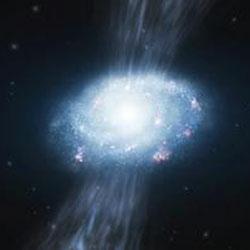
18. Galactic Clusters. At two billion years, galaxies arrange themselves in clusters, spherical bubbles of space with membranous surfaces made up of thousands of galaxies surrounding empty space measured in millions of light years. The surfaces of the clusters are chaotic and turbulent as droplets on the surface of an ocean wave striking a beach. This turbulence may explain how galaxies are capable of colliding with one another, giving rise to extensive new star formation. Indeed, if the big bang was originally characterized by a smoothly expanding spherical shock wave, small lumps, pockets, or ripples of increased mass density in certain local regions now give rise to gravitational great attractors that retard or distort the expansion of the big bang. As a result, what we observe today is a lacy collection of different size galactic bubbles, some of which are called clusters and some of which are now called super clusters, collectively forming a sort of foam. The space in between super clusters appears to be void.
19. Black Holes. These are essential singularities in space/time in which the gravitational field created by a sufficient mass at a point is so powerful that the light attempting to exit curves back into the interior, making it appear dark. Black holes like a vortex essentially swallow up any matter that has the "misfortune" to be near by. It is believed that most spiral galaxies house massive black holes in their centers. However, some regions of space may be densely sprinkled with "micro" black holes that could account for a substantial amount of the allegedly "missing" dark matter. These holes, which are characterized by parameters of center, event horizon, mass, and angular momentum, come in three flavors: static (spherically symmetric with no angular velocity), stationary (axisymmetric), and perturbed (completely asymmetric). Just as our sun looks relatively calm when viewed from a distance but in reality is quite turbulent when observed close up, so the throat of a black hole is even more tumultuous, with super-heated atoms slamming into each other, causing unexpected fusions. Layers of electrically-charged plasma orbiting at different speeds can sheer against each other tangling into a series of intense magnetic storms. Curiously, the black hole presumed to be at the center of our own Milky Way is unusually "black." Those in other galaxies emit far more visible light, while ours seems to keep its vast energy close to home, for whatever reasons that are yet to be explained.
20. White Holes. The counterpart of black holes, white holes would be space/time singularities that spit out newly-formed matter -- possibly a different phase in the evolution of black holes.
21. Worm holes. These are hypothetical tunnels through space/time systematically connecting black and white holes. Traveling along or through a worm hole, as far as time is concerned, make "all bets off." Such a topology makes for a universe with interesting properties, but the jury is still out on this mathematically interesting construct.
22. The Milky Way. A relatively undistinguished galaxy in a far off corner of the universe is known as "The Milky Way," which is part of a local group of about 75 galaxies in turn part of the Virgo Supercluster of local groups. Our Local Group, consisting of The Milky Way and the Great Spiral Nebula in Andromeda (somewhat larger than the Milky Way) can be thought of as the Queen and King of our region. They rule an empire of dozens of lesser galaxies that orbit them in the same way that moons do a giant planet.

360-Degree Photographic Panorama of the Milky Way, from the Viewpoint of Our Solar
System.
Structurally, the Milky Way Galaxy is a flat plate of [200 - 400] billion stars scattered in a set of spiral arms around a central bulge ( Sagittarius A*), which is believed to contain a massive black hole. The flat disk is surrounded by a spheroid halo of older stars. The entire disk slowly rotates with a period of [225 - 250] million years (corresponding to one Galactic Year). Thus, it is thought to have completed about [20 - 25] orbits since its birth. The main disk of the Milky Way Galaxy is [80 - 100] thousand light-years in diameter (about [250 - 300] thousand light-years in circumference) and outside the galactic core, about 1,000 light-years in thickness. Architecturally, it contains four major spiral arms ( Perseus, Norma, Scutum-Crux, and Sagittarius), all of which start at the galaxy's center, plus a number of smaller arms ( Cygnus, Orion, and Carina). For reference, our Sun is located on the inner rim of the Orion Arm about 26 thousand light years from the center ([60 - 70] percent of the way from the center). Also, something that may be difficult to appreciate is that the plane of the Milky Way the plane of the ecliptic of our solar system may not be parallel. What this means for the evolution of life, however, is not clear.
The Milky Way is not a static entity, but has its own internal dynamics. In January 2005, researchers reported that a heretofore unexplained tympanic warp in the disk of the Milky Way had now been mapped and found to be a ripple (or vibration) set up by the Large and Small Magellanic Clouds as they circle the Milky Way, causing vibrations at certain frequencies as they pass through the edges of the Galaxy. Thus, our sun "bobs up and down" (a vertical oscillation) with respect to the plane of the galaxy as though it were floating on the surface of a lake with waves propagating across it as a speed boat passes by. Thus, the trajectory of the Sun-in-space is sinusoidal, as the disk itself is rotating (clockwise). The period of this oscillation is 63.0 million years. As the upper face of the nebula is more exposed to cosmic radiation than the lower face (because of its neighboring galaxies), it is suspected that there is a cause-and-effect relationship with the periodic swings in the biodiversity of species that inhabit the surface of the Earth. Local minima of species takes place with a surprisingly-regular interval of 62 million years based on 500 million years of data. If sharp drops in biodiversity correspond to peaks in the intensity of cosmic rays, it may be that radiation damage to DNA has potentially lethal consequences thus causing the extinction of many vulnerable species all at once. The dinosaurs that became extinct 65 million years ago, however, don't fit this cyclic pattern (experts widely blame their extinction on the impact of a large asteroid that formed what is now the Gulf of Mexico. Herbivores could not sustain a multi-year dust blockage of the Sun that led to a decline in vegetation secondary to a loss of photosynthesis).
To help us get our bearings, the Nebula in Andromeda is an adjacent, neighboring galaxy toward which we are traveling at the rate of 250,000 miles per hour for a scheduled impact (or "pass through") in another 3 billion years. At least two very different outcomes might prevail post collision: The turbulence may (1) pull our local piece (arm) of the Milky Way far out into dark space or conversely (2) drive it in toward the center of the combined galax(ies). If there would be anybody left on the Earth to look up at the sky at night, if there still were an Earth and if there still were a night [and day] (if there still were a Sun [that had not yet transformed to a whte dwarf]), the experience might be quite different than what we are accustomed to. In the first case, the night sky would appear very dark indeed. In the second case, the "night" sky would appear very bright indeed [much brighter than a full moon], since the density of stars in the local neighborhood might be several orders of magnitude greater, and the effect would be of a multi-sun system that never led to real darkness except in times of exceptional alignment of local moon(s), providing, of course, that there still were moon(s) available for the purpose of a full multi-solar eclipse. However, it may be a moot point, since by the completion of the merger of the two galaxies in about 5 billion years, our Sun will certainly have burned itself out by then and the timing of all these untoward events is synchronized in a complex pattern so "what if" scenarios are tenuous.
A new simulation by Harvard Astrophysicist Avi Loeb predicts that the Nebula in Andromeda and the Milky Way Galaxies are on course to collide in only two billion years and that the galaxies will fuse within five billion years. In the mean time, as our universe continues to expand, all other galaxies will fade from sight in the night sky. Thus, we live in a very special time in the history of the universe in which the global universe is destined to become a very lonely place until the next "Big Crunch," which is much further down stream in time.
23. Solar Systems. At one to three billion years through the aggregation of massive amounts of dust, planets and their associated moons are formed around stars in an ecliptic plane. It is not unusual for moons to break apart and reaggregate themselves. So far, astronomers have identified 115 "extra solar" planets, at least one of which is in the center of a star cluster called M4 in the constellation Scorpius and was formed only 1 billion years after the Big Bang. The star at the center of the cluster is a pulsar, or neutron star spinning at nearly 100 times per second, emitting regular radio pulses like a light house.
Planemos are a new category of extrasolar objects that by weight would qualify as a planet if they were orbiting a star but are actually solitary, free-floating, dark orphans, possibly surrounded by a disk of dust or gas with enough mass to coalesce into their own miniature solar system. Some even appear to have their own planetary mass objects orbiting them and could be a nascent solar system in an early stage of evolution that has not yet gone fusion-critical.
24. Our Solar System. About four-and-a-half billion years ago, such a system of eight (8 + /- 2) planets were formed around Sol, a star located along the outer edges of The Milky Way. These planets are now called Mercury, Venus, Earth, Mars, {Asteroid Belt}, Jupiter, Saturn, Uranus, Neptune, {Pluto/Charon}, and maybe 2000 EB173 (a newly-discovered minor planet about 400 miles in diameter located beyond Pluto beyond the outer rim of the solar system and lies near a belt of comets called the Kuiper Belt. The standard planets possessed sufficient mass that their cores melted, allowing them to "sphericalize," instead of remaining a haphazard collection of lumpy subunits. The Ort Cloud consists of comets and dust that lie far beyond the limits of the Solar System.
Correction: Since its discovery by Clyde Tombaugh in 1930, Pluto has always been considered the ninth planet from the Sun despite its highly-eccentric elliptical orbit that ranges far outside the plane of the ecliptic. But in August 2006, the International Astronomical Union (IAU), in its wisdom, redefined the criteria for a "planethood," so as to exclude Pluto as well as other Trans-Neptunian Objects like Ceres and Eris, a Kuiper-Belt object, which, as it turns out, is slightly larger than Pluto. These peculiar objects are all now called Dwarf or Minor Planets. Interestingly, the Oort Cloud, extending beyond the Kuiper Belt, may contain billions of comet-like objects of unknown size, so there will be no end in new astronomical observations and discoveries, as better space-based telescopes are put in place.
The trajectories of the planets around sol are not really elliptical, since sol is also moving in space at a velocity of 84 Mm (megameters) per hour. Therefore, these trajectories are helical and the solar system has a visible tail, providing that one were located in the correct position to see it and it is estimated to be 150 GKm (billion kilometers) long or 1Kx the distance between the Earth and the Sun (1au). The cross section of the tail is estimated to resemble a four-leaf clover, given two pairs of high-speed particles that are flattened and twisted by galactic magnetic fields that cause a ribbon of charged particles to wrap around the edges of the heliosphere. Remember that the trajectory of Sol in space is not perfectly elliptical as the galaxy rotates about its center, but sinusoidal, as it bob up-and-down above and below the galactic plate, as we mentioned above. So the machinery of motion is indeed complex. Of course, our whole milky way galaxy is not just rotating but also moving somehow within its local group, but that behavior is hard to estimate beyond the fact that we will have an encounter with Andromeda sooner or later.
25. Sol. This star is a moderately-sized sphere with a boiling thermonuclear structure. Because it is not a rigid object, but a gaseous ball, its equator rotates more rapidly than its poles, 25 days in the equatorial region vs. 31 days in some polar regions. Wandering belts of gas (trade winds like the jet streams on Earth) between 17,000 and 40,000 miles across occur in both the northern and southern hemispheres. Like stripes on a barber pole, they start in the mid- latitudes and gradually move toward the equator. Solar eruptions called sun spots appear to form at the turbulent edges of these zones with a periodicity of approximately eleven years that extend their electromagnetic influence throughout the solar system.
According to a physicist who's modeled the effect of temperature fluctuations within our Sun, it may have a "dimmer switch" at its core that causes its brightness to oscillate in periods of around 100,000 years. This is exactly the same duration as occurs between ice ages on Earth. According to the standard model, the temperature of the Sun's core was to be held constant, while subtle changes in Earth's orbit was what was supposed to cause ice ages, but this view has persistent problems and variation in the Sun's temperature itself may better explain this empirically-observed ice-age phenomenon.
In terms of the natural history of the Sun, as with all stellar objects, it will continue to warm till in about one billion years from now the oceans of our Earth will have boiled off and the Earth's surface will have burned to a crisp. In about five and a half billion years, the Sun will expand to a Red Giant. Only a few thousand years are needed for the temperature of the Sun to grow to 30,000 degrees K. At this temperature, the Sun will begin to emit large quantities of UV radiation. This UV radiation is capable of ionizing the Hydrogen shell of matter that escaped from the Sun during an earlier phase. Eventually, exhausting its fuel supply, it will cool off becoming a mere Earth-sized White Dwarf that dims to a Black Dwarf, essentially a cold, dark, ignominious lump of carbon.
26. Earth. [5.54 BYA], The inner solar-system planetary bodies (Mercury, Venus, Earth, and Mars) began forming much earlier than astronomers previously believed, within 10,000 years after Sol ignited. However, even after 10 million years, the third planet, Earth, had only reached about 64 percent of its present size by a slow process of dust accretion. Earth had a fortuitous distance from its star with a period of revolution that is now referred to as one year, although this duration has lengthened over the course of geological time over what it once was. It also had an appropriate angular momentum allowing for rotation around its own axis (forming days [and nights] of 24-hour intervals, each hour further subdivided into 60 minutes, each minute further subdivided into 60 seconds, in an arbitrary manner). The shape of the sphere became an "oblate spheroid" due to the angular momentum of its daily rotation. Seven of these intervals are given the name week and were named accordingly (Sunday, Monday, Tuesday, Wednesday, Thursday, Friday, and Saturday). Its axis of rotation had an appropriate declination angle with respect to the plane of the ecliptic (23.5o +/-10 o). This angle is responsible for seasonal variation ( Fall, Winter, Spring, and Summer). It was established in 1891 that location of the North Pole tends to drift slowly about 20 feet to-and-fro with a period of 433 days. This so-called "Chandler Wobble" has now been explained (in the year 2000) as due to the fluctuating pressure on the bottom of the ocean, secondary to temperature/salinity changes and wind-driven changes in the circulation of the oceans.
We recently learned of a local oscillation with a period of 5.9 years in which our 24-hour day is sinusoidally altered by milliseconds due to the sloshing movements of fluids in the Earth's corer. This is independent of the linear upward drift in the 24 hour day toward longer times due to our Moon's drag on the Earth (We had a shorter day of only 22 hours 500 million years ago), therefore, injecting or removing leap seconds in our day makes no sense to correct for this short type of cycling (Nature, July 11, 2013). We have even observed sudden rotational speed changes called "geomagnetic jerks," that defy explanation.
A curious observation is that life on a rocky planet like the Earth depends on the presence of heavier elements in the Periodic Table being present in space at the time of the formation of the solar system of which this planet is a part. This in turn depends on first-generation neighborhood stars having been through a supernova that "seeds" heavier elements into the neighboring space, since the space around primordial first-generation stars following the Big Bang would only be rich in Hydrogen and Helium, so rocky crusted (sandy/watery) planets couldn't even form. Indeed, in a survey of 120 galaxies that were formed around a billion years after the Big Bang vs. a set of 21 comparable younger galaxies, the younger galaxies were in the process of synthesizing new stars at 10x the pace (~500 new stars per year).
27. Luna. A singleton moon is called Luna, whose period of rotation is called a month, almost 12 of which fit into one year, naming these months accordingly ( January, February, March, April, May, June, July, August, September, October, November, and December). The Moon's mass and distance from the Earth played a significant role in tidal flexing of the Earth's oceans. It also provided significant illumination on the Earth during darkness, depending on the relative juxtaposition of the three astronomical bodies: Sun, Earth, and Moon.
Apparently, Luna was formed 4.5 billion years ago (surprisingly recently) when a massive rogue planet (at least as massive as Mars) struck the Earth and blew off huge chunks of matter into space. These pieces formed ring(s) (like the rings of Saturn) which subsequently aggregated into a single body that "sphericalized" once the inner core melted/liquified (due to the intense pressure within the interior). [These events have been simulated by researchers at the Southwest Research Institute in Boulder, Colorado.] Over time, the moon has moved away from the Earth (at the rate of three feet per Century) from a distance of no more than 10,000 miles away to 240,000 miles away today. In the beginning, the Earth's day may have been only five or six hours long, as energy from the Earth's rotation is lost through tidal ocean drag. Thus, the moon's gravitational drag has slowed the spin rate of the Earth, such that by 500 million years ago, it slowed to 22 hours. Thus, the biological clocks of all organisms alive at that the time were adapted to a somewhat faster circadian rhythm. Today, of course, it's 24 hours. In the future, the day will continue to lengthen, and adaptation will presumably continue.
The presence of numerous large and small craters on the surface of today's moon -- without an atmosphere to erode its history -- provides testimony that the solar system was at one time a much more busy and crowded place, densely packed with asteroids that were pulled toward and crashed into on any high-gravity objects nearby. Today, such objects are relatively sparse. Even though the early Earth must have been an equal victim to such bombardment, the evidence for such craters on our own surface is relatively rare, owing to wind/water erosion. One might ask if the moon is still being hit by asteroids or meteors today? By bouncing laser beams off the Moon, astronomers have discovered that it "sways" in its orbit by a few meters forward and back with a period on the order of three years. Like the oscillations of a huge bell, still ringing long after it has been clanged, Luna is acting as though it had been struck by a large object with the last 1,000 years. Our Earth is scheduled to "welcome" a sizeable asteroid or other object (Code named "2000 SG344") in our vicinity around the year 2030. A more serous one is scheduled for September 16, 2071. Stay tuned for updates from NASA and the International Astronomical Union (IAU).
A curious side effect of the moon's solar reflection on Earth is that people sleep less deeply within the four nights of a full moon, even if they are shielded from moonlight in a windowless lab (Current Biology, July 25, 2013). This tells us that we must have a monthly lunar- cycle clock hidden in the brain's SCN similar to the circadian rhythm of the 24-hour clock that syncs up with daylight with the pineal gland, depending on the season of the year. Sea creatures obviously have lunar clocks to keep track of the tides, and that's where we came from once upon a time.
28. Earth Structure. The Earth, whose mass, by definition, forms a gravitational field of 1 g, was formed with extraordinary complexity throughout, especially regarding its surface. It possessed an atmosphere, a lithosphere, and a hydrosphere. The atmosphere burned up most of the meteors that fell toward the Earth, leaving only a few significant impact craters. The ozone layer in the upper regions of the atmosphere (stratosphere) served to filter (protect against) the ultraviolet rays of the Sun. As the planet cooled, the lithosphere, composed of separate hard tectonic plates, formed as a crisp shell (punctuated with "pin" holes) around a molten central core, whose character is still revealed to the surface today in the form of volcanoes occasionally spewing hot molten fluid (lava). The molten core contained large concentrations of the element iron, whose magnetic properties served to protect the planet further with a radiation-shielding magnetosphere; not all planets are so endowed. The motion or the plates ( continental drift) is still detectable today in the form of earthquakes. From an initial primordial continent ( Pangea or Gondwanaland) 550 million years ago visible above the hydrosphere, a number of subcontinents ( North and South America, Europe, Asia, Africa, Australia, and Antarctica) with wrinkled texture ( mountains) emerged. These continents partitioned the hydrosphere into oceans ( Atlantic, Pacific, Indian, etc.). Organic molecules (composed of Carbon [with an electron shell of four electrons, making it ideal for linear chaining], along with the elemental building blocks of Oxygen, Hydrogen, Nitrogen, Sulfur,...) formed initially in a liquid soup in the oceans now laden with salt, giving to it an appropriate osmotic pressure.
29. Climate and Weather. Rain (floods/hurricanes/cyclones/monsoons/typhoons and drought), snow, ice, hail, desert sandstorms, and electrical discharges (lightening/thunder) further served to erode, cook, churn, and electrify the organic pot. Rain also formed lakes, ponds, puddles, and rivers. Over millennia, ice ages came and went (just a 3-5oC reduction in the average temperature of the Earth is sufficient to trigger an ice age with longer Winters and cooler Summers lasting Centuries). This further distorted geological formations on the Earth's surface. As the precession of the Earth around its axis-of-rotation caused it to wobble and nod with a periodicity of 22,000 years, the stronger Summer sunshine at higher northern latitudes was probably responsible for the end of ice ages every 100,000 years or so. These last three items were important to establish the proper ecological boundary conditions for the formation of life on Earth. There is continuing controversy as to whether these boundary conditions are commonplace around the universe and that life or even intelligent life has arisen spontaneously elsewhere, and that it is therefore worth attempting to communicate with "them." To help establish this hypothesis, it is fashionable to represent the probability of intelligent life appearing on any planet as a mathematical product:
PI = n1 x n2 x n3 x ... x n(delta)
where PI (the capital Greek letter PI) is the probability of intelligent life in the Milky Way, n1 is proportional to the number of stars in our galaxy, and many of the other n's are fractions, like the fraction of such stars that are likely to have planetary systems, etc. It should be pointed out that even for any large number of stars n1, there is a sufficiently large (delta) such that PI turns out to be infinitesimally small. In other words, we may very well be alone in the universe, and the SETI Project, despite the cogent arguments put forth by the late Carl Sagan to the contrary, may well be a big waste of money. Also, one can imagine other kinds of scenarios besides the romantic Star Trek model for how intelligent alien species might interact with Homo sapiens [See Ref. B18, Ward and Brownlee and Ref. B20, Aczel which further elaborates on the 7-factor Drake Equation {Francis Drake, 1961}]:
1. Everyone listens, no one talks. (this is paradoxical) (Also, remember inadvertent TV signal leakage);
2. Raising one's hand attracts attention to one's self, leading to one's demise. (Heisenberg's Principle);
3. There's a conspiracy of advanced civilizations who are secretly observing us but haven't approved us for membership in their club yet, as, in their view, we're not sufficiently mature [B40];
4. Conversations prove uninteresting for various other reasons:
a. Their IQs are immeasurably low (bacteria, "can't fog a mirror," "no EEG [brain dead]," "Don't bite my finger, look where I'm pointing,");
b. Their IQs are quite low ("they move their lips while reading"); or
c. Their IQs are extremely high (we're the ones who appear to think like bacteria!).
At this time, we cannot accept the so-called Cosmic Imperative Hypothesis which suggests that life always arises spontaneously, given the proper initial/boundary conditions (a plentiful supply of solar-energy photons, carbon atoms and other low atomic weight atoms that are normal constituents of organic molecules [like H, N, O, S, Cl, Na, K, Ca, etc.], liquid water undergoing some degree of turbulence [stirring/churning], electrical discharges [lightning], pH not far from 7.0 with moderate pressure and temperature variations, and sufficient time [perhaps 2-3 billion years]. A single data point, life on Earth, does not constitute proof, no matter how many millions, billions, or trillions or Earth-like planets may exist in other solar systems throughout the universe, notwithstanding the possibility that life might have existed at one time on Mars (and is now extinct) or in the oceans under the ice of one of the moons of Jupiter (Europa), as it is now fashionable to imagine. There is no known law of physics that compels life obligingly to arise under ancient earth-like conditions. The beginnings of life on Earth are lost in the mists of time as the fossil trail peters out 3.5 billion years ago. This "if you build it, they will come" hypothesis fondly urged by astrophysical chemists who have shown that various amino-acid building blocks could arise spontaneously given the right boundary conditions, also falls short of the sort of evidence we need.
While amino acids are like "bricks," life is like an elaborate "house" made up of simple bricks. Except in a cartoon running a video tape in reverse, have you ever seen a hurricane assemble a house out of a pile of bricks? On the other hand, everyone can imagine that a hurricane can "disassemble" a house into a random pile of bricks in a very short time. Simple bacteria are self-reproducing organisms of exquisite complexity made up in part of self-replicating molecules (DNA). There is a minimal number of genes (perhaps 100) needed for the simplest type of bacterium that could ever be naturally constructed and still be alive. Dr. J. Craig Venter, CEO of Celera Genomics Group of Rockville, Maryland, is now proposing to conduct an experiment of this sort starting with one of the simplest bacteria known (200-300 genes) and selectively deleting genes one-at-a-time until the creature stops being capable of reproduction, no matter which gene is chosen for deletion. It is likely that results of this experiment will be reported in the next five years.
Proponents of Creationism firmly believe that even if one successfully evolved a family of one-celled organisms (like bacteria), one could never bring about a complex creature with eyes to "see," simply by means of "natural selection." For them, such visual organs are obviously too complex to imagine without recourse to a "miracle" to help explain the eye's very existence. On the other hand, evolutionary theorists have now proven that many types of eye-like photo sensors could have evolved independently more than 40 times over the broad span of paleontological history. An interesting new data point has recently shed some light on this debate... We know that bricks can be used to build either an aqueduct to deliver water (Roman engineers did it often) or a gothic cathedral to worship God (Europeans built many fine examples in Italy, England, France, Spain, and Germany). Conventional wisdom ascribes great intelligence to the architect of the cathedral; the builder of an aqueduct is merely an engineer. Think of the complex blueprints needed to specify a magnificent cathedral, you say. Now think of the dim- witted brick-layer; not too much intelligence is demanded of the mason who makes the bricks, right? Just make a brick and do it again, and again, and again, ten billion times if need be. Now think of the complexity of a multicellular organism (the cathedral) compared to, say, a single- celled organism (the brick). What would you say is the ratio of complexity between these two? Prof. Gerald M. Rubin of the Department of Molecular Biology of the University of California at Berkeley and Chairman of the International Drosophila Consortium has just provided us with the following surprising data point (March 24, 2000; Science): A fruit fly (complex creature)'s genome is now know to contain 13,601 genes along its four chromosomes [ Drosophila melanogaster]; while a yeast (simple one-celled creature)'s genome contains 6,241 genes on its chromosomes [ Saccharomyces cerevisiae]. Curiously, a lowly microscopic worm (or nematode) contains 18,424 genes [ Caenorhabditis elegans]. Conclusion: Half the complexity of a magnificent creature is in its bricks! The other half is, indeed, needed to specify the embryogenic program (ontogony) that delivers the proper phenotype (phylogony), but it's not 10 or 100 times more complex. Wow! I didn't know that.
So how long would you have to wait for a monkey sitting at a keyboard striking keys randomly to produce the works of Shakespeare? Is this the same as asking "How long would it take for a hurricane to assemble a house out of bricks?" even if there were an ample supply of appropriate bricks just lying around? But, we must appreciate that the evolutionary force of natural selection, once started, is quite different than the random force of a cyclone or a tornado. We may call the transition from wind to life a stochastic inflection or singularity.
Another observation about the unlikelihood of other intelligent life forms in other parts of the visible universe is the following: There do not appear to be any non-wild-type stars in our field of view. All stars and/or galaxies that we know about appear to have been scattered, if not randomly, at least by natural stochastic processes. And their energy profiles appear to be random as well. So, for example, there do not appear to be any three-dimensional geometric arrangements of stars that would conspicuously be detected as artifactual (despite the belief of early astrologers who fancied that stars actually do form geometric patterns which they called the zodiac), which would be evidence in favor of "star engineering" for the specific purposes of an advanced intelligent race. Just as one can tell at a glance from satellite photos or form airplane overflights that certain areas of the Earth's surface have been cultivated (farm land with geometric patterns of planting is more efficient for the purpose of harvesting), as distinguished from naturally-occurring forests (corn does not look the same as random pine trees), we don't see the equivalent of a regular array of stars, let alone the equivalent of a British "Crop Circle in the Sky." If intelligent aliens existed anywhere at all, some of them would almost certainly be ahead of us in technological sophistication, since there are a lot of stars that are older than our Sun. So assuming that they had the knowhow and the will to rearrange stars to suit their purposes as we rearrange bricks to suit our purposes, it would be hard to conceal the evidence in favor of artifacts. [By the way, if humans were ever anxious about revealing their presence to any advanced civilization that may be lurking in the neighborhood, it's already too late. Our cities glow at night in a distinctly artifactual pattern in a manner that is difficult to control. A virginal, uninhabited planet (or conceivably one controlled by an intelligent but paranoid life form who attempted to conceal its presence by surreptitiously maintaining radio/telephonic silence and keeping its heat and light pollution to a minimum) would have a characteristic signature to an external observer in scanning mode, whereas a real civilization that actually did things would have a very different signature and be detected quickly.] To conclude this thread, our current inability to detect star "cultivation" does not represent incontrovertible proof that there are no intelligent aliens out there. It may suggest instead that really advanced civilizations meet their energy needs in radically different ways and./or that they have no interest in "rearranging" the visible star field but deliberately choose to maintain an ecologically-natural universe in their own backyard.. [ Editor's Note: To further speculate about what intelligent agents (who have already solved the problem of "instrumentality" and can exist in a perpetual state of pure contemplation) is beyond the scope of the current discussion. See the next essay on this website entitled The Return of the Krell Machine by Steven B. Harris for speculation of the Science-Fiction implications of a civilization that learns how to pass through a "technological singularity" and safely come out on the other side.]
Before completing Chapter 1 and our discussion of the physical universe from the big bang to the present time, it might be useful to touch on what our cosmological/physicist friends forecast about how the universe is expected to end ( eschatology) and whether intelligent beings, such as ourselves, might even be around to witness such an event. It is now widely accepted in this community (at least for the last four years) that the universe will continue to expand and cool forever (modulo some non-zero Kelvin temperature associated with what is called Hawking Radiation). The idea that the universe will collapse, due to gravity, and implode at some point into a "big crunch" is now discredited due to the suggested presence of so-called "dark matter" characteristic of empty vacuum (3/4ths of the hypothetical matter/energy in the universe is now believed to be invisible or "dark."). Indeed, highly luminous exploding stars dubbed Type Ia Supernovas can be used to gauge the distances and motions of galaxies with unprecedented precision, and it now seems that the most distant galaxies are moving more slowly than we would expect from observations of nearby galaxies, an indication that the universe has more recently sped up. Thus, astronomers are now convinced that the rate of expansion of the universe is accelerating! One wouldn't expect to see this if only gravity were at work. This phenomenon is now attributed to the "dark energy" present in seemingly empty space (As we mentioned earlier, Albert Einstein invented a fudge factor, which he called the "cosmological constant," to help his relativistic equations balance, and he subsequently called this contrivance "the greatest blunder of my career," but he may now be shown to have been truly prescient). One may not be happy with the choice of ice over fire as a way to end things. But one cannot be justified in having an informed opinion on these matters. Even though we know that Nature's laws can be simple, if she wants them to be, just as often Nature is extravagant, and there is no reason why the universe cannot be more extraordinary than we dare to imagine.
The implications of this accelerating permanent expansion are truly profound. We will get to see less and less (if we're still around) of the universe our astronomers know and love. About 150 billion years from now, almost all the galaxies in the universe will be receding fast enough to become invisible from the point-of-view of the Milky Way (their seeming rate of departure will exceed the speed of light). The galaxies in our so-called "Local Group" (of which our Milky Way is a member) will still be visible, however; so from an Earth naked-eye-perspective the night sky would still look the same (even though the Earth itself will have been incinerated long before by the extinguishing of our own Sun), although astronomers would certainly know the difference through modern telescopes, if they still had any. About 100 trillion years from now, most of the interstellar gas and dust from which new stars condense will finally be used up. Thus, no new stars will be born. From that time on, the sky will grow darker and darker, photons will become a scarce commodity, and nighttime will become a permanent state of affairs. All of us will find the sky sadly empty; the fireworks display will be over. Now the serious struggle by intelligent life to capture energy will begin in earnest, since just thinking requires energy which in turn generates heat that must be dissipated somehow. Maybe the "event horizons" (surfaces) of black holes will become a precious commodity after all, since they will still spew out energy from time to time in a landscape of perpetual darkness. However, according to the laws of Quantum Thermodynamics if we wait long enough, anything can happen, even the creation of a new "big bang." Thus, on this relatively optimistic note, so ends Chapter 1.
Except that we should acknowledge that we have not attempted to address certain metaphysical/cosmological questions that are occasionally asked by philosophers with way too much time on their hands, like (1) whether the universe described above is a singular event or might there not be an infinity of such universes (a multiverse)? Or (2) Might not some of these universes, if they exist, be able to merge with ours under the right circumstances, leaving us the possibility of escaping from an inevitably frozen death under the present central dogma? Or (3) Is there a "prime mover," what ever that means? Or (4) What happened before the "big bang"? [33] Clearly, there are a lot of semantically or pragmatically meaningless questions that can be posed in English (or any natural language that serves as its own meta language) that have the ring of grammatical correctness and therefore must be answerable in principle. Wrong! There are plenty of syntactically correct English sentences that are, in fact, meaningless. This is the sort of argument that the Logical Positivists of the Vienna Circle [1922 - 1935] sought to avoid, and so we will deliberately avoid indulging in further discussions of this sort.
Chapter 2
1. Life. The first billion years on Earth are
known as the azoic era (without life), sometimes called the Hadean Era
by geologists because they imagine it so resembled the Biblical description of Hell. The
surface was largely covered with molten volcanic rock (or lava). Oceans, if they existed at all,
frequently boiled away into a superheated incandescent mist due to the impact of large numbers
of meteors that slammed into the Earth with a fabulous intensity and great frequency
(inhospitable to say the least). These collision events would not merely extinguish a particular
species or two, making it thereby extinct, but routinely sterilize any incipient life form
whatsoever on our infant planet.
Indeed, we have now learned that there were at least five great mass extinctions that
obliterated more than 50 percent of all living creatures on this planet. Ironically, we may be
witnessing a sixth great extinction in our contemporary times, secondary to humans'
technologically-advanced methods for intensively farming the land, burning down the jungles,
hunting elephants and rhinos, etc., and fishing the oceans at industrial-strength levels, resulting in
climate change as one small consequence, but mainly producing a tide of destruction for innocent
botanical and zoological species that could not possibly defend themselves against our human
penchant for radically changing the world to suit our own short-term, self-indulgent needs.
Editorial Remark: Is this sort of behavior consistent with "stewardship" or what?
Ref.: George C. McGavin, Endangered: Wildlife on the Brink of Extinction
(Firefly; 2006; $35.00).
However, at about [4.3 - 3.5] BYA in the Precambrian Era, Archaea, the first
of four major Biological Domains gained a foothold that they never released.
[Note that the so-called five kingdoms (animals, plants, fungi, bacteria, and
protozoa) have now become obsolete in describing the taxonomy of life.] This first domain
consisted of prokaryotic (or single-celled) organisms that were generally heat loving
(hyperthermophilic) and evolved in what we would call exotic environments like boiling hot
springs, active volcanoes, or deep-sea ocean vents with continuous seepage of hot sulphurous
salt-water. Furthermore, they typically produced methane as a byproduct of their metabolism
rather than carbon dioxide. But they were composed of a traditional DNA
molecule (a linear or circular, double-helical, informational molecule containing a
sequentially-coded blueprint for recreating the cell's three-dimensional architecture) and other
structures surrounded by a bilayer lipid membrane sack (or oil droplet). They were capable of
multiple functions: irritability ( tropisms), metabolism of energetic molecules
( autosynthesis), mitotic division ( reproduction), and
adaptation to a constantly changing environment. DNA expresses its information content
from the primary strand by a process of selectively transcribing messenger RNA (from
genes [introns splicing out exons]) and, with the help of other
machinery in the cytoplasm (ribosomes), fabricating long polypeptide chains of amino acids
(proteins). Some of these proteins function to support the cell's structure while others serve as
enzymes to promote the dynamic activity of various biochemical reactions needed to maintain the
health and well being of the cell. Random alterations in the DNA sequence during replication
( mutations) may occasionally be beneficial (adaptive), so far as the next generation
of organisms is concerned. Most changes, however, are useless, and many are lethal. Prokaryotic
cells were the first players at the "slot machines" of life. They solved many "multiple lock-in"
problems (one needs three "lemons" all lined up in order to be permitted to keep on playing).
Adaptation to an unruly external environment, forced the invention of cybernetic control and
homeostatic equilibrium in the parameter state space. Considerable numbers of failed
experiments littered the landscape (extinct species); but fortunately for us, these cells never
stopped playing the game.
Factoid: Earth's oceans appear to be teaming with bacteria-phage viruses. There may be ten times as many of these viruses as there are of all other living creatures on Earth put together. Each ml of ocean water holds about 50 million virus particles and these organisms kill 20 percent of the bacteria in the ocean every day. In the process, viruses move gene sequences from one bacterium to another, speeding up evolution, and even turning some bacteria into human pathogens. Curiously, most of these viruses are single stranded DNA.
2. Eubacteria. This was the second major biological domain. It also consisted of prokaryotic organisms whose metabolism is based more on consuming oxygen from the environment. Even today, it is estimated that these first two domains together account for 80 to 90 percent of the world's biomass.
3. Eukarya. This was the third major biological domain. As molecules combined in ever more complex patterns of growth, there arose a new cell type with its DNA packaged in segments called chromosomes with centromeres in the middle and a pair of telomeres at the tips which were surrounded by their own lipid compartment (nuclear membrane). Other specialized organelles also evolved or were captured from the environment (mitochondria [for energy], vacuoles [for storage], smooth and rough endoplasmic reticulum [for internal transport]. At about 3 billion years ago, simple single-celled plants were formed surrounded by a stronger "wall." They engaged in photosynthesis, which permitted more reliable conversion of photonic energy directly from the sun, using a specialized organelle called a chloroplast. This had subsequent implications for the gaseous composition of the atmosphere. In Australia, recently discovered tiny crystals in rocks called hematite (iron oxide) hint that photosynthetic green plants (containing chlorophyl) began ~3.46 BYA (Billion Years Ago), much earlier than originally thought.
4. Giant Viruses. Giant Viruses are a brand-new (hypothetical) major biological domain. With the discovery of hexagonal mimiviruses that infect amoeba, evolutionary biologists believe that they have identified a parasitic life form larger in size than small bacteria. In ancient times, this form may well have been an autonomous, free-swimming creature whose genome was only slightly pared down over time. These viruses are large and complex with genomes that rival the simplest bacteria along with enzymes that are specific for building their own unique proteins. They are clearly embedded at a very high level in the fabric of life and may soon be granted the status of a fourth biological domain. [C24]
5. Multicellular Organisms. Switching our temporal reference to one billion years ago, these cells became capable of aggregating into multicellular arrangements (organisms) with a complex architecture and differentiated tissue types. The first multicellular organisms were microscopic worms and feasted on clumps of bacteria. Multicellular animals became widespread during the early Cambrian period, 540 million years ago. Hormones became chemical messengers that could operate at greater distances than would be possible by simple molecular diffusion alone (which is normally adequate for intracellular distances). Then evolved full endocrine and cardiovascular systems, as highways, to move hormonal and nutritional molecules toward their receptor end-organs and targets, respectively. Similarly, neurons were invented to control distant activities with significantly shorter response times than could be accomplished by endocrine means alone. These, in turn, evolved into full nervous systems, both central and peripheral. Immune systems were subsequently invented to perform necessary house keeping and security functions in response to a continuous exposure to a flood of pathogenic microbes. Concurrently, embryogenesis was invented to solve the problem of developing an adult (multicellular organism) from an egg (single cell). This included, blastulation, gastrulation, and neurulation. Curiously, the majority of genes needed to construct an adult organism turn out to be employed not in building visible adult structures but in specifying design (blue prints) and organizing scaffolding (which is later torn down, a process called apoptosis or Programmed Cell Death [PCD], as distinguished from necrosis or Traumatic Cell Death [TCD] by suffocation). Forests especially redistributed the composition of the atmosphere toward much higher concentrations of Oxygen (nearly 20 percent). Nitrogen, Carbon Dioxide, Argon, and a few other rare gases persisted. Analysis of a deep rock core taken from Australia reveals the presence of measurable concentrations of oxygen in atmosphere 2.3 to 2.4 billion years ago. Before that, Earth's atmosphere was dominated by Methane and Ammonia, hardly hospitable to life as we know it.
6. Movement to the Land. At about 570 million years ago, at the time of the so-called "Cambrian Explosion," swimming creatures moved from the ocean on to the land. The reverse migration of earth-based creatures back to the ocean, like whales and dolphins, happened much later but the up-and-down tail movement is characteristic of all mammals who swim, as distinguished from the side-to-side tail motion of fish.
7. Sex. At 460 million years ago, two or more genders ( male and female) were invented to better mix the gene pool and segregate recessive genes in case of emergency (a clever mechanism to hedge one's bets on the vicissitudes of a fickle, stochastic environment). Meiosis was invented to mix the chromosomes of the egg and sperm ( haploidy) without doubling the amount of DNA per organism ( diploidy).
8. Dinosaurs. About 250 million years ago in the Paleozoic to Mesozoic Eras, dinosaurs were largely cold-blooded creatures at the top of the food chain, who later became extinct apparently as a result of a single catastrophic event-- a massive meteor crashed into the Earth before it could fully burn up in the atmosphere creating a giant crater. The dust from this anomalous impact blocked the sun for several consecutive years (perhaps decades). Without sunlight and the benefits of photosynthesis, the dark Earth must have been a truly inhospitable place for nearly everyone.
Chapter 3
1. Changing and growing, animals and plants thrived and multiplied. Their reproductive capacity, as always, was based on random mutations in their DNA over many generations, permitting them the opportunity to adapt to changes in the Earth's environment. They competed with one another through a process of natural selection (Darwinian Evolution) sometimes referred to as "survival of the fittest." A complex food chain (or web) of predators and prey evolved with over 100 million species of plants and animals in larger communities and ecosystems.
2. Fish and other creatures. Some ocean dwellers adapted to their aqueous environment by swimming (fins). Along the way, insects learned to fly, spin webs, and hop. Some plants flowered for the sake of more efficient pollination by bees and wasps. Still other plants cleverly invented fruit with a similar agenda, so that animals might distribute their seed more widely than could be done by wind alone. Conversely, other plants invented poisons to prevent themselves from being eaten, like certain mushrooms. Snakes wiggled. All sorts of extraordinary creatures flourished and multiplied. This engendered an astonishing array of adaptations to solving the problems of life, including cooperation (commensalism), carnivorous plants, and parasitism (viruses, etc.). Aging and senescence of individual organisms, by the way, was merely a side effect of the selfish genes "running out of things to do" (their developmental programming). The "Darwinian Game" can only be played during the interval between birth and reproductive adulthood (the ability to rear one's children to independence in the next generation). Natural selection has no way to influence one's genes beyond that interval, in order to experiment with new variations. Thus, the "prime directive" extropy (directed increase in complexity) is replaced by its converse, entropy (blind decrease in complexity). In general, a species' specific lifespan ( lambda), its parity (average number of offspring at birth), age at birth, age at puberty, age at menarche (female menopause may have value in successful grand mothering) and other similar species-dependent parameters are all random variables under the continual adjustment of a genetic program embedded in its DNA, so as to enhance species' adaptation to its environment (cline or ecosystem) or its reproductive capacity subject to the presence of predators and the supply of prey.
3. Mammals. In the Devonian Period (mid Paleozoic) 400 million years ago, certain fish crawled out of the sea and onto the land becoming amphibious, extracting oxygen directly from the atmosphere through the use of lungs (a novel adaptation). A combination of tides from the Sun and Moon were crucial to this trend. Those who preferred life exclusively on dry land soon they became reptiles. Later, about 135 million years ago in the Jurassic Period of the Mesozoic Era, they became mammals, warm-blooded creatures (a very useful but expensive adaptation). Some mammals later rejected the land and returned home to the sea (whales and dolphins). Others, like dogs, cats, rats, sheep, cattle, elephants (mastodons), horses, camels, lions, and tigers decided to stay. Birds fly by flapping their wings (another really useful but expensive adaptation to escape from predators). Mobility was especially valuable because of the strong incentive to migrate in the North/South direction in view of annual seasonal variations from hot to cold and hours of daylight that vary with time of year (melatonin enabled). Without this incentive, intelligent life might never have evolved. Instead, equatorial banding patterns (like exist on Jupiter) is all that we would ever have.
4. Hominids. Around 300,000 years ago, hominids were hairy mammals (monkeys who lost their tails and other great apes) who walked upright on their lower extremities (to facilitate the carrying of spears) and developed a thumb with opposed digits on their upper extremities (to facilitate the grasping of tools). This was much more flexible than having an extremity without the potential of an interchangeable tool (or weapon). Survival depended on aggressive maintenance of territory and control over potential mates. All hominids thrived and multiplied, even up to the present time, with one exception -- Although it is not explicitly mentioned in our recorded history (either written or oral tradition) because this history hardly goes back more than 8 - 10 thousand years and this "event" happened somewhat before that, it is now speculated that as recently as 100,000 years ago, we were not alone (unique). There may have been dozens of different human-like species who evolved contemporaneously (rather than serially) and shared common territory (in Africa or on other continents). Indeed, there may have been as many as half-a-dozen human-like species as recently as 25,000 years ago; but they are now all extinct, except for one of them -- us. Furthermore, we probably were not innocent bystanders in this extinction, but active participants in this process-of-elimination in an intensively competitive environment along with other creatures (predators). Perhaps this is one of the events that contributed to our sense of being "chosen" or "special."
Chapter 4
1. Homo sapiens. Implicit within the big bang were not only the necessary and sufficient conditions appropriate to the development of life but even intelligent life. Not only was there a star with nominal magnitude sufficient to supply a stable quantity of photons to its planets over billions of years with at least one of the planets having the appropriate mass, plate tectonics, period of revolution, spin, declination (tilt angle), and moon(s) with correct mass, revolution, and rotation to engender fluid tides (sister planets Venus with none and Mars with two, both too small, didn't qualify, so far as we know), there was a migratory incentive for life to develop the use of instrumentality (tools) and a rich self-referential mode of communication (natural language with a variety of personal pronouns). 300 KYA (Thousand Years Ago) in the Pleistocene Epoch of the Cenozoic Era, modern men evolved from a hominid species endowed with an extra layer of brain tissue on their cerebral cortex. This provided an unprecedented intelligence and linguistic competence (morphology, syntax, semantics, and pragmatics) especially suited to the organization of complex cooperative (tribal) endeavors, like communal hunting. The old brain remained essentially unchanged (savage). About 140,000 [+/- 10,000] years ago, modern man descended (ascended) out of Africa and established his presence (dominion/hegemony/stewardship) over virtually all continents following a pattern of successive waves of migration across the various land/ice bridges available at different geological times.
About 74 KYA there was a catastrophic near-extinction event causing demise of many animals including H. sapiens following the eruption of a volcano called Mt. Toba in modern-day Sumatra, INDONESIA. Most hominids on the Earth died off due to a lack of food, when ash covered the atmosphere causing permanent Winter conditions for [7 10] years, except for a small group of a few thousand humans living in South Africa. That may explain why 99.9 percent of our DNA is so highly conserved among all humans no matter what their physical appearance or racial phenotype.
One curious side effect of the ability of at least certain human females to be aware of their own ovulation but to conceal it from others (in particular, their husbands), leads to the construction of very complex social entanglements, like vows of fidelity in marriage, and conversely the evolutionary survival value of deliberate deception (in the continuing search for males with the best possible genes while still maintaining a guaranteed economic provider waiting in the wings). Promiscuity is impossible in principle for bitches (female dogs who broadcast their estrus with a special fragrance throughout the neighborhood along with a noticeably swollen vulva as a canine species survival strategy) or even most primates, like great apes who don't live in tribes but in harems (but conspicuously not chimpanzees, the males of which possess extremely large testicles used to synthesize lots more sperm to compensate for their fickle females frequent surreptitious, extracurricular liaisons). It has been recently estimated by random DNA analysis of the population that, unbeknownst to them, about ten percent of all human fathers are not the true biological father of the child they are seeking to raise to reproductive independence.
2. Our new voluminous brains (fed by a meat diet) led to the discovery of prodigious amounts of knowledge, both of the "What" and the "How to" variety ( Observational and Interventional Knowledge, later to be the distinguishing feature between gratuitous scientific information and useful engineering know-how).
3. What-type knowledge included the recognition of mortality (there is a difference between acute illness leading to full recovery and chronic illness leading to senescence and death, the common fate of all sexually-reproducing creatures who age). Another significant revelation for cave dwellers was an appreciation of the biological laws governing fertility, i.e., the equal participation by males and not just females in the production of offspring (the temporally-separated, non-obvious cause-and-effect relationship between copulation and procreation). This led to the concepts of spouse, family, tribe, inheritance, and primogeniture. Pronatalism became codified in tax law as well as religious dogma subject to the much later proscriptions against incest, adultery, and unnatural methods for birth control (natural methods include extended periods of breast feeding which can postpone new pregnancies for years, a rhythm method, and coitus interruptus, while unnatural methods include the various types of contraceptives).
4. How-to- type knowledge included how to make sharpened stone hand-held axes to carve meat (made the same way for several hundreds of thousands of years), pointed spears for hunting (rather than opportunistic gathering or scavenging), beads made of shells with holes for decorative necklaces, bracelets, and other jewelry (dated to 40,000 years ago), caves for sleeping (cave paintings in France have been dated to 34,000 years ago), sewn clothing to keep warm, fire to cook with and for light-at-night to scare away predators, domestication of wild animals (like wolves who were transformed into dogs [curiously, all canine subspecies from Great Danes to Chihuahua were evolved through selective breeding supervised by humans only over the last 15,000 years], cats, and other pets, horses [mules], and beasts of burden [llamas, camels, etc]), agriculture to provide for a more stable food source, numbers for counting (zero), irrigation and dams to deal with drought and flood aqueducts, city and monument building (architecture and observatories to facilitate the prediction of solar/lunar eclipses and equinoxes), the bow (and arrow), the wheel, metallurgy (bronze), money (coins) to trade with, writing (phonetic alphabet), paper, ships, the compass, glass optics (for telescopes, microscopes, and spectacles), gun powder, cathedrals, steam engines, books (printing press), guns, electricity, light bulbs, interchangeable parts, assembly lines, skyscrapers, antibiotics, anesthetics, indoor plumbing, telephones, photography/movies, cars, freeways, gas stations, planes, rockets, birth-control pills [RU486], "talkies," television, atomic/hydrogen bombs, communication and GPS satellites, copy machines, FAX machines, HDTV with simulated-theater stereo surround sound, computers (the late Prof. Alan Perlis of Yale coined the 11th Commandment: "Thou shalt compute!"), robots, artificial intelligence, genome sequencing, nanotechnology, the Internet, cloning of sheep, mice, cows, etc., therapeutic stem-cells, and all sorts of extraordinary and astonishingly-wonderful things. [According to Profs. Nathan S. Lewis and David Goodstein of CalTech in Pasadena, California, the total energy consumed by all humans on the planet in 2003 was estimated to be 13 Tera Watts. Assuming a rise in population from 6 to 10 billion persons in the next 40 years, consumption will then rise to 28 Tera Watts (billion watts) by 2043. Obviously, given this rise in the level of demand, reliance on fossil fuels for energy cannot continue at its present rate.] (My apologies if one of your favorite technologies was left off of this approximately-chronological list.)
Chapter 5
1. Knowledge. History records the accumulation of knowledge at an exponential pace. However, lest we become overconfident, we should remember that 99 percent of our species' history on this planet was prerecorded history, and it is unclear to what extent life before 6,000 years ago was enjoyable or frightening. Our forefathers may have spent many millennia shivering at night in a dark cave hoping to make it through to the next day before technology became sufficient to deliver us from the relative uncertainty of imminent extinction. Ironically, major problems of today tend to be concerns like obesity and overpopulation. And although the neocortex led to the invention of extraordinary civilizations, the old brain still functions quite well "thank you." We are regularly reminded that the veneer of civilization is only skin deep. Mankind's recorded history is largely a history of warfare, characterized by the increasingly sophisticated technology needed to sustain the winners. The 20th Century put the Northern Hemisphere of Earth at great risk for Nuclear Winter. In general, history has been more like "Dodge City" than "Paris in the Spring!" Civil disturbances ranging from the Watts riots to the recent Los Angeles riots are sad contemporary events without clear solution. Nevertheless, the abolition of slavery, the rise of democratic institutions (universal suffrage), inalienable human rights, and the establishment of the United Nations are steps in the right direction. As a corollary to the experience of other extinct species, we need remind ourselves that there is no guarantee that human progress is inevitable, and dystopias are just as likely as utopias. By the way, just as a simple statistic: 95 to 97 percent of all species that have ever lived on the planet are now extinct. What is really different in the last 10,000 years, as a result of the presence of human beings on the planet, is that the rate of species extinction has increased by approximately an order of magnitude over what it traditionally had been over many millennia (with the exception of cataclysmic events, like comets impacting the earth and cutting off sunlight for substantial periods of time [such as a decade]).
2. Epistemology. To facilitate progress, knowledge partitioned itself into a rational framework: logical (deductive, inductive), metaphysical (cosmology, teleology, ontology, mind/body problem), ethical (casuistry), and aesthetic. Data led to information, facts, scientific principles ( physical laws), and collections of hypotheses ( theories) that evolved into the traditional academic disciplines: mathematics (modern algebra, analysis, topology, probability theory, and stochastic processes), physics, chemistry, biology (botany, zoology, ecology, molecular), psychology, economics, etc. and the professions: medicine, law, engineering (electrical, mechanical, chemical, civil, robotics), politics, theology, art (architecture, poetry, literature, music, dance), etc. that are prevalent on most respectable university campuses today.
3. God. Contrary to most genesis stories, we have thus far avoided the use of the term God to represent an immortal, omniscient, omnipresent ( ubiquitous), omnipotent, and otherwise perfect being. In different cultures He/She has been referred to as Lord, Supreme Being, Mysterium Tremendum , Jehovah, Elijah, Yahweh, Immanuel, Allah, Buddha, Ormazd (also Ormuzd) [The chief deity of Zoroastrianism, the creator of the world, the source of light, and the embodiment of good. Zoroaster founded his religious system in Persia (Iran today) who taught that there is a universal struggle between the forces of light and darkness and shared with Judaism the concept a "chosen people" and "waiting for a Messiah to appear upon the Earth." By the way, it is now speculated that the "three magi" (the Wise Men bearing gold, frankincense, and myrrh as gifts for the baby Jesus of Nazareth, born April 16, 6 B.C. (not December 25, 0 B.C.)) were not Kings from India, Ethiopia, and Persia, or even kings at all, but rather Wizards (astrologers) all from the city of Babylon who observed that the Moon eclipsed the planet Jupiter in a special Sign of the Zodiac, foreshadowing the birth of a King (of the Jews).], God-the-Father (from the Trinity [including as well the Son and the Holy Ghost]). Curiously, some cultures have imagined a Deist God (Creator, but now passive observer) while others have insisted on a Theistic God (Creator and active ruler-- answerer of prayers, issuer of commandments, capable of inflicting severe punishments, creating miracles at will, etc.), or even Pantheist God(s) (multiple divine persona who preside over specialized "domains of expertise," like hunting, fishing, fertility, and so forth, as is commonly found in Indian, Greek, Roman, or Norse Mythology and are largely characterized by "magical thinking" of the Witch/Wizard /Sorcerer variety). Other characteristics of God that can be inferred either from the above or from statements attributed to Him in the King James Bible include, singular, self-aware (conscious), autonomous, willful agent with His own agenda (self-actualized), teacher of right and good, surrounded by a hierarchy of angels who do His bidding, made in our image (since he made us in His image, and image, by definition, is a symmetric relation), desires to be worshiped, jealous, and even vengeful toward those who do not observe his commandments. Those who do not believe are called atheists, idolaters, heathens, infidels, or pagans by those who do adhere to the true faith. Those who have not yet formed an opinion are contemptuously called agnostics. Those who express belief, but secretly deny it, are called hypocrites. For some, who maintain strict hegemony over their constituents, those who once professed their faith, but no longer do so, shall be excommunicated. On the other hand, in a secular society, individuals are given the freedom to chose their own religious path, whether atheism, monotheism, or polytheism, whether empirical/rational or based solely on divine revelation by the prophets or Saints. This whole issue of intolerance introduces an entirely new sacred vocabulary to deal with one's antagonists... terms like martyrdom, bigot, blasphemy, heresy, betrayal, sectarian dogma, and holy war (as distinguished from a just war, whatever that is) and its Islamic synonyms ( Jihad and Intefada).
Karen Armstrong [A41] states that the new atheists like Richard Dawkins, Daniel Dennett, Sam Harris, and Christopher Hitchens have "thrown out the baby with the bath water" in their collective attacks on modern literal religions. In the earliest recorded versions of religion, God was not considered as a Supreme Being who made us in his image --- a more powerful human writ large. Thus, she says, "It is inappropriate to use pronouns like He/She/It to describe God, as God is beyond any linguistic description. God is a transcendent [stochastic] force in the universe that cannot be bounded within the scope of any natural language.
But, quite to the contrary, the best model of God that can be derived from the earlier sections of this Book of Genesis would invalidate nearly every one of the characteristics promulgated by conventional religions (ubiquitous, all-knowing, all powerful, etc.) and replace them with a substantially new, diametrically-opposed set of attributes that might even be thought of as incomprehensibly-alien to the uninitiated (but not necessarily an atheistic doctrine). In particular, the new model of God would *not* give Him a gender (male/female) or even a number (singular/plural). [For the sake of convenience, let's stick with the linguistic pronoun "He," at least for the moment.] Furthermore, He would *not* be "omniscient," "omnipresent," "omnipotent," or "perfect." Finally, the attributes of "self-aware," "autonomous," and "willful" [Remember all the talk about "God's Will be done."] would also have to go. The idea of a passive creator being "jealous" or "vengeful" [a means to distinguish the one true God from prior organized religions that practiced Idolatry] wouldn't even make sense, semantically. Neither does the concept of a force, as in the Start Wars... "May The Force be with you." make sense.
Another problem that traditional religions have to deal with is called the problem of theodicy, defined as how to reconcile the injustice between an omniscient/omnipotent but loving (benevolent) God on the one hand who on the other hand permits the presence of evil and substantial suffering in the real world. One of the rationalizations for this apparent contradiction offered by traditional religions is that God chose to allow man "free will" but Eve (and Adam inadvertently) disobeyed Him (Original Sin), so mankind (their progeny) must be punished for all future generations (posterity) with the potential for terrible suffering. A world filled with horrible suffering would be allowed if the original intent of God was a good one. Sure. So how can our new characterization of God obviate the problem of theodicy?
The first positive divine attribute would have to be "creator of the physical and the mental universe(s)." God created the Heavens and the Earth alright, but, secondly, He would also have to be a "mathematician," since He clearly created all sorts of interesting and counterintuitive idealizations like the concept of "number" that he left for us to find out about on our own (integers, rationals/irrationals, reals, and particularly transcendentals (like "pi" [Remember the ancient Greek complaint that they couldn't square a circle using a compass and a straight edge. How could they know that pi, the ratio of circumference to diameter {C/D} in a circle {the locus of points equidistant from a center}, was a transcendental number? The concept of "countable" vs. "uncountable" infinity had not yet been invented. How could some infinities be more dense than others?] and "e" [which "magically" appears in mathematics again and again in random processes and not just as the base of the natural logarithm]). However, God was a particular type of mathematician. He didn't especially fancy Algebra; but he obviously took a fancy to Analysis, and Stochastic Processes in particular [Think "white foam" every time an ocean wave crashes on the shore as a model for what stochastic processes are all about or, if you prefer, the pattern of "shadows on the ground" as the sun shines through leaves of a tree while the wind blows.] Stochastic processes are all around us. By definition, Stochastic Processes are continuous (not discrete) time-based random events that permeate our universe]. The key to such processes is that they are truly random. They are cruelly Darwinian. They are not guided by design. They have no will. They have no purpose. They have no intent. Therefore, no teleology is needed to explain them. God did not create the force of stochastic processes, he is the force of stochastic processes. He is the foundation for the "Big Bang." Therefore, attributing all of these standard intentionality properties to Him like "will" is ludicrous. He is the personification of "willlessness,": providing we allow this neologism to enter the English language. Indeed, He is the epitome of "coin flipping." He is relentlessly pointless. So, don't even ask to "do his will." He doesn't have one. We are really alone out here. One can find neither comfort nor guidance from above. [Note: Our challenge to the traditional argument for the existence of God by " Intelligent Design" (ID), does not mean that we should obviate the " Anthropic Principle" (AP) as well, lest we eliminate the possibility of a universe in which human beings could even exist in principle.]
If we take it upon ourselves to rule our planet, it is by our choice, not by having been given permission/authorization to do so by God. If there are ecologically-sound criteria for good stewardship of life on Earth, so be it. But it is our doing. God could care less if our species became extinct tomorrow, just as he didn't shed a tear for the dinosaurs when they became extinct. (By the way, the vast majority of species that have ever emerged from the mud over archeological time on this planet are today extinct, so it would be exceptional if we even lasted a half-million years) Indeed, He wouldn't shed a tear if the Earth fell into the Sun tomorrow and the entire "experiment" went up in smoke. [By the way, the Earth will, in fact, "go up in smoke" in about five billion years when our Sun is slated to evolve into a red giant followed by a white dwarf . And the Earth will be uninhabitable long before then, since our inconsistent Sun will gradually warm up and produce a run-a-way green house effect on the Earth (think Venus). Hopefully, we'll be routinely living out beyond the Ort Cloud by then.] So remember, God is a non-caring force in this universe. And we had better prepare for all of these contingencies (not just wayward asteroids that could hit the Earth at any time). Finally, we must take personal responsibility for our ill-mannered behaviors (like warfare or "benevolent/blessed terrorism"), if we are to make it even to the next millennium. And it's a matter of choice not fate.
Consider the following summary of the fundamental differences between the models of creation presented by The Judeao-Christian Book of Genesis and The Revised Book of Genesis above...

Obviously, the two models provide quite different "Prime Directives" and implications for what is permitted or desirable - in short, what we should be doing with the rest of our lives.
4. Human Immortality. Recall that, in the original King James' version of the Book of Genesis, God specifically prohibited Adam and Eve from eating the fruit of either of two forbidden trees, of distinguished consequence, that were growing in the center of the Garden of Eden:
(i) "The Tree of Knowledge" (the fruit of which they ate); and
(ii) "The Tree of Life" (the fruit of which they did not have an opportunity to eat).
Their punishment for this crime was eviction from the Garden. "And lest they attempted to return and become immortal like God himself, He posted cherubim to the East armed with a 'whirling and flashing sword' to guard the path."
We, therefore, reckon that the "trajectory" back to the "Tree of Life" was never intended to be a simple matter. For example, to our knowledge, no one has ever speculated about the prospect of circumnavigating these second-ranked archangels by slipping back through the garden's "Western Gate," or even whether there are supposed to be other gates, simply because there was an explicit mention of an Eastern Gate. [;-)
It is presumed that these metaphorical trees are intended to pose certain moral dilemmas:
(i) Must we really be punished for having acquired all of our current knowledge (sexuality/reproduction, mortality, technology, etc.)? and
(ii) How do we become just like God, anyway?
Consistent with our current Revision of Genesis, the irreverent answers to these questions are as follows:
(i) No. Through the careful acquisition of knowledge, we shall be rewarded, not punished; and
(ii) With difficulty. By intensely hard work (in the laboratory) shall we find that for which we seek.
Someday, hopefully soon, we shall be able to say, "The time we have dreamed of is at hand." Then, we shall rightfully take our place on Mt. Olympus amongst the gods themselves.
In the mean time, we should not be ashamed to confess our true desires to anyone who wants to know. This is the "big enchelada," and its going to take a lot of collaboration to get it right. So we had better start working to make this a team effort.
Here Ends the Revised Book of Genesis
EPILOG
Some may argue that our Revised Book of Genesis has ended too soon. After all, the real Bible goes on to tell us about a lot more "stuff." However, from our point of view, the rest of the traditional Bible(s) (both Old and New Testaments) are myths and should be studied in school under a curriculum of Comparative Mythology along with the myths of other cultures from classical Roman, Greek, and Norse Mythology including Native American Indian Mythology. Every culture creates explanations for its young people to help them answer, at a minimum, three basic questions that they all have: (1) Who am I?; (2) Where am I?; and (3) Where am I going? Along the way one also may acquire some more or less gratuitous information like why men must have fewer ribs than women (as Dr. Isaac Asimov pointed out, beginning medical students taking Human Anatomy for the first time are often disillusioned to discover that both genders have an identical number of ribs). Thus, the subsequent stories of Adam and Eve (on Earth), Cain and Abel (fratricide), Methuselah (extreme patriarchal longevity), Noah and the Ark (the pairing of the animals and the creation of the rainbow after 40-days-and-40-nights of nonstop rain), The Tower of Babel (and the origin of divergent languages), Moses (and the Ten Commandments), Jonah (and the Whale), Job (and adversity), Samson and Delilah (who gave him an unflattering haircut), Solomon (who wisely feigned cutting a baby in half). Other prophets like Abraham, Joshua, Isaiah, Jeremiah, and Ezekiel provided both warnings and comfort - warnings against idolatry and comfort to those who suffered from guilt. (Idolatry is not the same as paganism. Pagans were nonmonotheistic but nevertheless could be spiritual. Idolatry is something else. Those folks enraged the prophets by engaging in abominable rituals that debased human values.) Solace and comfort could be obtained by repentance and redemption coming from a purification of the soul. The New Testament stories of Jesus (and his disciples) and The Revelation ("The Lake of Fire") are myths to be used for didactic or pedagogical purposes.
Our revised Genesis would be considered revisionist by the strict interpretationists. Revisionists believe that editing the Bible is OK, since the Bible that we know-and-love is actually a fairly late monotheistic rewrite of much earlier heathen texts that were cobbled together to establish a consistent one-God theology that would be compelling to illiterate peoples. The biblical historicists, on the other hand, while allowing for some redaction resulting from translation from Hebrew and Aramaic, see their document as genuine revelation conveying accurate historical facts. Revisionists, like us, wish to continue in the spirit of the ongoing editing process that we have always had.
Instead of the traditional prophets, our own patriarchs shall include Aristotle, Leonardo da Vinci, Copernicus, Galileo, William Harvey, Francis Bacon, René Descartes, Isaac Newton, and Charles Darwin. See the Book Page in the Resources Section for a more complete list.
* A more appropriate, if somewhat heretical, proposal for time
keeping (rather than "BC" [Before Christ] and "AD" [ Anno Domini]), might be
"BG" (Before Galileo) and "AG" (After Galileo), when empirical investigation or science as a
means of acquiring knowledge began in earnest. If we arbitrarily allow that 1564 AD (the year of
Galileo Galilei's birth) is calibrated to 0 AG, then today's date, February 7, 2003; 9:00 PM
GMT would be represented as 439.02.07.21:00:00 AG.

For more details on the life of Galileo, click on his picture for the Nova Special produced
by WGBH in Boston and first aired on PBS KCET-TV in Los Angeles on Tuesday, October
29th; 8 - 10 PM PST (TRT = 2 hours). There are video clips from the program on the
Nova/WGBH website. Curiously, Galileo was a medical student for a brief time in his
educational career. Furthermore, before he became a true scientist, he could have been
considered an engineer, since he negotiated a substantial contract with the Venician Navy for the
delivery of high-resolution telescopes for use on-board ships (to detect the presence of enemy
ships before they could see you).

By the Spring of 1609, simple three-power telescopes were available both in France and in Italy.
But it was Galileo who made the instrument famous. In August of this year he presented a similar
telescope to the Senate in Venice. In the Fall of that year, he turned a 20-power instrument
toward the heavens, and with this instrument, he observed our Moon and announced the
discovery of four major moons orbiting Jupiter ( Io, Ganymede, Europa, and Callisto
). The painting above, entitled Galileo Presents His Telescope to The Doge in
Venice, by Luigi Sabatelli (born in Florence in 1772 and who died in Milan in 1850) was
painted as a fresco on the ceiling of the Tribuna di Galileo in the Museum of the History
of Science in Florence.
Prof. Bart Kosko of the Department of Electrical Engineering at the University of Southern California in Los Angeles has suggested a still better (different?) means for time keeping ["Does Anybody Really Know What Time It Is?" The Los Angeles Times, p. B11 (December 31, 2002)] would be to note that recorded history and thus our modern civilization really began about 10,000 years ago with the rise of agriculture. All else in human experience might justifiably be considered the "pre-history" of our hunter-gatherer ancestors and therefore not relevant. Thus, only about 500 generations have passed since then (500 x 20 = 10,000), and then nobody we would ever want to talk about like Aristotle or Confucius would ever have the embarrassment of having being born in "negative time." After all, the Muslin Calendar says that the year 2003 is really 1423, while the Chinese Calendar says it is 4699, the Jewish Calendar says 5763, and the Hindu and Aztec Calendars say hundreds of other years. So according to Dr. Kosko, 2003 should really be 10,003. It was an accident of natural selection that God gave us ten fingers and not 8 or 12. Therefore, we have the decimal system, the metric system, as well as decades, centuries, and millennia in our vocabularies. It is an entrenched cultural prejudice that we use the Gregorian Calendar (with names of months in honor of Roman Emperors) and its bizarre technique for calibrating "leap years." It is a historical accident as to which group first invented guns, steel, and the printing press. So let's give proper credit to all our worthy ancestors by setting the original zero "set point" so that they all get the respect they deserve. Happy 10,003!
In the interplay between action, ethics, and human destiny, contemporary religious thinkers are profoundly concerned with God's intention for people regarding the issues of dominion over the natural world (technology), stewardship (responsible dominion), and divine sovereignty (decisions unto God alone). Did God just command humans with an imperative to "go forth and master the world" or is there also an obligation to preserve nature ( Genesis 2:15)? We believe that our fate will be revealed whenever our species is ready to migrate/evolve to the next level beyond Homo sapiens, a new species unencumbered by "instrumentality." The term instrumentality refers to the present requirement for human conscious thought to manifest its intention through the intermediary of physical/biological bodies. The solution to the "problem of instrumentality" does not entail resort to psychokinesis or telepathy as these terms are understood in parapsychology today. We just have no way to comprehend, at present, what will appear on the other side of the "technological singularity" toward which we are headed in the next century. May you live in interesting times.
It has been proposed by some of our computer-science colleagues that at some point in the future (perhaps as an exercise for the reader?), we will need to create a new foundation for the evolution of this document -- in XML (Extensible Markup Language) [rather than the present HTML (Hyper Text Markup Language)]. The (semantic) meta tags in XML for the different Chapters and Verses have yet to be designed. They must include all the tags needed to provide full coverage for any genesis story ever written (or told) in any language throughout recorded history. A subset of such tags might be as follows:
<metaphysics>
<ontology>
< time> < space> < cosmology>
<teleology><intensionality><purpose><free will/fate>
</metaphysics>
<theology>
<life-history>
<fertilization><embryogenesis><fetogenesis><sexuality><geriatrics&g t;
</life-history>
<eschatology>
</theology>
<epistemology>
<linguistics>
<phonology>
<morphology><lexicon><punctuation>
<syntax>
<semantics>
<pragmatics>
</linguistics>
<perception><awareness/self-awareness/consciousness><mind/body>
</epistemology>
<logic>
<deductive inference>
<inductive inference/statistics>
<rhetoric><sophistry>
</logic>
<ethics>
<aesthetics>
But this is just a start.
Work is currently underway for the Axiomitization of our Theology and Religious Orientation using the formalism of an Abstract Mathematical Meta Model. Click for more details.
If you are reading this document in hard copy, it may already have become obsolete. In addition to presenting a set of static references below to document some of our more controversial hypotheses [as they will undoubtedly become dated in a number of months anyway], we urge the reader to visit the Gerontology Research Group Website: www.grg.org to find our most current list of references. This website is a "living" document that we intend to update regularly (at least quarterly).
Here are current references as of < January 2003> grouped into four separate categories:
A. Philosophical/Theological
1. Bill Moyers, Genesis: A Living Conversation with Bill Moyers (Doubleday, New York; 1996).
2. Robert Alter, Genesis: Translation and Commentary (W. W. Norton & Co.).
3. Stephen Mitchell, Genesis: A New Translation of the Classic Biblical Stories (Harper Collins, New York; 1996).
4. Burton L. Visotzky, The Genesis of Ethics (Crown Publishers).
5. Avivah Gottlieb Zornberg, The Beginning of Desire: Reflections on Genesis (Doubleday, New York; 1995).
6. David Rosenberg, Ed., Genesis As It Is Written (Harper, San Francisco, California).
7. Naomi H. Rosenblatt and Joshua Horwitz, Wrestling with Angels: What Genesis Teaches About Our Spiritual Identity, Sexuality, and Personal Relationships.
8. Ada Feyerick, Genesis: World of Myths and Patriarchs (New York University Press, New York; 256 pp; $59.95;1997).
9. Shabaz Britten Best, Genesis Revised: The Drama of Creation (Sufi Publishing Company, Farnham, Surrey, England; 1964).
10. Jonathan Kirsch, The Harlot by the Side of the Road: Forbidden Tales of the Bible (Ballantine Books, New York; 1997).
11. The QuickVerse 4.0 Deluxe Bible Reference Collection on CD-ROM for Windows, Teacher's Edition with 12 translations (Parsons Technology , $379 plus S&H; 1-800-779-6000; http://www.parsonstech.com/software ).
12. Niles Eldredge, Dominion (A John Macrae Book/Henry Holt, New York; 1997).
13. Karen Armstrong, In the Beginning: A New interpretation of Genesis (Alfred A. Knopf, New York; 1997).
14. James L. Kugel, The Bible as It Was (The Belknap Press of Harvard University Press, Cambridge, Massachusetts; 1997).
15. Norman Golb, Who Wrote the Dead Sea Scrolls?: The Search for the Secret of Qumran (1993).
16. Alan Harrington, The Immortalist: An Approach to the Engineering of Man's Divinity (Random House, New York; 1969).
17. Keith J. Laidler, To Light Such a Candle: Chapters in the History of Science and Technology (1997).
18. Michio Kaku, Visions: How Science Will Revolutionize the 21st Century? (1997).
19. Kenneth C. Davis, Don't Know Much about the Bible: Everything You Need to Know about the Good Book But Never Learned (Eagle Brook Books, William Morrow, New York; 1998).
20. Richard Elliott Friedman, The Hidden Book in the Bible: The Discovery of the First Prose Masterpiece (Harper, San Francisco; 1998).
21. Bruce M. Metzger and Michael D. Coogan, Eds., The Oxford Companion to the Bible (Oxford University Press, New York; 1993).
22. Michael D. Coogan, Ed., The Oxford History of the Biblical World (Oxford University Press, New York; 1999).
23. John Rogerson, Ed., The Oxford Illustrated History of the Bible (Oxford University Press; 2001; 416 pages, 115 illustrations, $45.00).
24. Alister McGrath, The Story of the King James Bible and How It Changed a Nation, a Language, and a Culture (Doubleday, New York; 2001).
25. Steve Allen, Steve Allen on the Bible, Religion, and Morality(Prometheus Books, New York; 1990).
26. Galileo Galilei [1564-1642], Manoscritto (Three Italian Manuscripts) [Le operazioni del compasso geometrico, et militare -- Dichiaratione intorno all uso del compasso geometrico, o militare di Galileo matematico dello studio di Padova -- Mecchaniche dell'instrumento, La natura de cinque piu semplici stromenti, Lieva, argano, taglia, vite, e corico, quali tutti si riducono in corto modo in un solo (copied in calligraphy by several different scribes c. 1606 on parchment and bound in leather by the personal li brary of the family of Count Giampaolo Rocco of Napes, Italy and acquired by the California Institute of Technology Rare Book Archives; Pasadena, CA c.1955; c. 1606).
27. Carsten Peter Thiede, The Dead Sea Scrolls and the Jewish Origins of Christianity (Palgrave, St. Marin's Press, New York; 256 pages; 2001).
28 Philip R. Davies, George J. Brooke, and Phillip R. Callaway, The Complete World of the Dead Sea Scrolls (Thames and Hudson; ISBN: 0500051119; June 2002).
29. Bernard Lewis, What Went Wrong: Western Impact and Middle Eastern Response (Oxford University Press, New York; 2001).
30. Euene H. Peterson, The Message: The Bible in Contemporary Language (NavPress, Colorado Springs, CO; 2,265 pp.; $28.00; 2002).
31. Dick Teresi, Lost Discoveries: The Ancient Roots of Modern Science From the Babylonians to the Maya," (Simon & Schuster, New York; 2002).
32. Norman Podhoretz, The Prophets: Who They Were, What They Are? (Free Press; New York; 2002).
33. Tim Callahan, Secret Origins of the Bible (Millennium Press, Altadena, CA; ISBN: 0-9655047-8-6; 488 pp; $29.95; 2002).
34. Michael Ruse, Darwin and Design: Does Evolution Have a Purpose? (ISBN: 0- 674-01023; Harvard University Press, Cambridge, MA; 2003). Why do certain features of nature, particularly the sophisticated adaptations to the biological world we observe as plants and animals, seem to call for explanations in terms of purpose? This fallacy results from a narrow anthropomorphic point of view. Thus, there is a strong temptation to characterize biological creatures using the language we invented for human artifacts, objects that were created by a designer for a purpose (like a fountain pen, for example). Many have turned such "evidence for design" into arguments for the existence of God. For example the 19th Century Rev. Francis Henry, Earl of Bridgewater, set aside an endowment of 650,000 pounds (about $650,000 today) to demonstrate how "the wise and benevolent design of God was revealed in the complexities of the natural world." Does that sound like "begging the question" to you? God meant for the lion to sink his teeth into the neck of the antelope? To get to the bottom of this problem, the Templeton Foundation funded philosopher-of-science Michael Ruse ($100,000) in this first of seven books to be published by a series of scholars. Darwinian natural selection produces artifact-like features by chance (a tiger's tooth, for example) evolving randomly to benefit its possessor. The language of design (intentionality) should serve only as a handy metaphor, like "Nature abhors a vacuum," which falls perfectly in this same category. The principle that "water flows down hill" follows from the Second Law of Thermodynamics. Occasionally, while going down hill, water can cause turbulence, an extremely complex, non-linear process that exhibits all sorts of counterintuitive behavior. It doesn't mean that water "wishes," "desires," "hopes," "wants," or "expects" to go down hill; it just does.
35. Taner Edis, The Ghost in the Universe: God in Light of Modern Science (ISBN: 1-57392-977-8; Prometheus Books, Amherst, NY; 2002).
36. Victor J. Stenger, God: The Failed Hypothesis: How Science Shows That God Does Not Exist (ISBN: 978-1-591-2-481-1; Prometheus Books, Amherst, NY; 2007).
37. Sam Harris, The End of Faith: Religion, Terror, and the Future of Reason (W. W. Norton and Company, New York; 2005).
38. Sam Harris, Letter to a Christian Nation (Alfred A. Knopf, New York; 2006).
39. Richard Dawkins, The God Delusion (Houghton Mifflin Company, New York; 2006).
40. Edward Humes, Monkey Girl: Evolution, Education, Religion, and the Battle for America's Soul (Ecco; 380 pages; 2007).
41. Karen Armstrong, The Case for God (Alfred A. Knopf, New York; 2009).
42. Stephen Cave, Ph.D., Immortality: The Quest To Live Forever and How It Drives
Civilization (Crown Publishers, New York; 2012).
Cave defines four Narratives of Immortality: (1) Staying Alive (Post Singularity Transhumanism;
SENS; Bridge Plan(s)); (2) Resurrection (traditional Christian mythology); (3) The Soul
(Egyptian Ka) ( Eastern Reincarnation); and (4) One's Legacy (through one's work and one's
progeny/students).
43. Ray Kurzweil, The Singularity is Near: A True Story about the Future (DVD Deluxe Edition; 2012). (Interviews with Marvin Minsky, K. Eric Drexler, Robert A. Freitas, Jr., Bill Joy, and Aubrey de Grey, included).
44. Clifford A. Pickover, The Medical Book: From Witch Doctors to Robot Surgeons, 250 Milestones in the History of Medicine (Sterling, New York; 2012).
B. Physics/Astronomy/Cosmology
1. Timothy Ferris, The Whole Shebang: A State-of-the-Universe(s) Report (Simon & Schuster, New York;1997).
2. David Filkin, Stephen Hawking's Universe: The Cosmos Explained (Harper Collins Publishers, New York; 1997).
3. Jonathan Allday, Quarks, Leptons, and the Big Bang (1998).
4. Ernest J. Sternglass, Before the Big Bang: The Origins of the Universe (1998).
5. James B. Seaborn, Understanding the Universe: An Introduction to Physics and Astrophysics (1998).
6. Stuart Clark, Stars and Atoms: From the Big Bang to the Solar System (1995).
7. Stuart Clark, Towards the Edge of the Universe A Review of Modern Cosmology (Wiley, New York; 1997).
8. T. W. Hartquist and D. A. Williams, The Chemically Controlled Cosmos (1995).
9. Jeremy Bernstein, An Introduction to Cosmology (1994).
10. Martin Rees, Before the Beginning: Our Universe and Others (1997).
11. P. J. E. Peebles, Principles of Physical Cosmology (1993).
12. Ben Zuckerman and Matthew A. Malkan, Eds., The Origin and Evolution of the Universe (1996).
13. Alan Guth, The Inflationary Universe: The Quest for a New Theory of Cosmic Origins (1997).
14. Guido Münch, Antonio Mampaso, and Francisco Sánchez, Eds., The Universe at Large: Key Issues in Astronomy and Cosmology (1997).
15. Rocky Kolb, Blind Watchers of the Sky: The People and Ideas that Shaped our View of the Universe (1996).
16. David Deutsch, The Fabric of Reality: The Science of Parallel Universes -- and Its Implications (Penguin; 1997).
17. Avishai Dekel and Jeremiah P. Ostriker, Eds., Formation of Structure in the Universe (Cambridge University Press, New York; 1999).
18. Peter D. Ward and Donald C. Brownlee, Rare Earth: Why Complex Life is Uncommon in the Universe (Copernicus Books, New York; 2000).
19. Fred Adams and Greg Laughlin, The Five Ages of the Universe: Inside the Physics of Eternity (Touchstone, New York; 2000).
20. Amir D. Aczel, Probability 1: The Book that Proves There Is Life in Outer Space (Harvest Books, New York; 2000).
21. Martin J. Rees, Our Cosmic Habitat (Princeton University Press; 2001).
22. Timothy Ferris, Editor, The Best American Science Writing: 2001 (Harper Collins, New York; 2001).
23. K. C. Cole, The Hole in the Universe: How Scientists Peered Over the Edge of Emptiness and Found Everything (Harcourt Brace; 2001).
24. Stephen Hawking, The Universe in a Nutshell (Bantam Press, New York; 2001).
25. Brian Greene, The Elegant Universe: Superstrings, Hidden Dimension, and the Quest for the Ultimate Theory (W. W. Norton & Company, New York; 1999).
26. Alan Guth, The Inflationary Universe.
27. Murray Gell-Mann, The Quark and the Jaguar: Adventures in the Simple and the Complex.
28. Joseph Silk, The Big Bang, 3rd Edition (W H Freeman and Co, New York; ISBN: 0716738783; 2001).
29. James Powell, Mysteries of Terra Firma: The Age and Evolution of the World (Free Press; New York; ISBN: 068487282X; 2001).
30. Stephen Wolfram, A New Kind of Science (Wolfram Media, Inc.; ISBN: 1579550088; 1192 pages; 2002).
31. Eric J. Chaisson, Cosmic Evolution: The Rise of Complexity in Nature (274 pp., paperback; HUP; 2002).
32. Robert P. Kirshner, The Extravagant Universe: Exploding Stars, Dark Energy, and the Accelerating Cosmos (Princeton University Press, New Jersey; 2002).
33. Charles Seife, Alpha & Omega: The Search for the Beginning and End of the
Universe (ISBN: 0670031798; Viking Press, New York; 2003).
The Roman Catholic Church long refused to abandon a geocentric (Ptolemeic) model of the solar
system in favor of a helicocentric (Copernican) model, consistent with modern astronomical
observations. It was only a few years ago, 400 years later, that Galileo was finally exonerated by
the church for his seemingly heretical views. (This leads one to wonder about the so-called
Doctrine of Papal Infallibility. After all, since each Pope speaks only to God who
presumably knows all divine truth, how can one Pope say one thing on one occasion, while
another Pope says the very opposite on another? But then again, the history of the Papacy over
many centuries reveals a tragic record of inconsistency, so clearly this cannot be the standard of
"Catholic Infallibility." It's more like, "You had better pay attention to what either I or some
other Pope may have said at an earlier time, unless I happen to change my mind, in which case
you are safe in ignoring the earlier doctrine and need attend only to what I say today, since that is
what is right and will remain right unless I chose to change it tomorrow.")
This book provides not so much an understanding of the universe as a better awareness of what
and how much there is still to be understood. For example, (1) Is our universe a singular
phenomenon or might there be an infinity of parallel universes (a multiverse in hyperspace)? By
the way, if we were embedded in a multiverse, this could go a long way toward obviating a deep
philosophical argument in favor of the existence of God based on the Anthropic
Principle, i.e., since we are here to observe the universe, and we could only be here if the
universe were of such a flavor as to support the existence of life; and whereas most other
potential universes with different values for the strong, weak, electromagnetic, and gravitational
forces (or other parameterizations of universal constants like the speed of light or the mass of a
neutrino) that precipitated from the big bang would not support the presence of galaxies with
stars (very strange places indeed), let alone life, our universe must be a fortuitous event that
could only have been possible through the design of an intelligent agent (God). If there were an
infinite number of universes to choose among, that would allow for pure chance to operate in
explaining why we're allowed to be here observing anything at all, not an intelligent agency. (2)
Could these individual universes of a multiverse touch at one or more places like leaves of a
thick book (allowing for the presence of Star Trek "worm holes")? (3) Could universes in a
multiverse merge or mingle in some way before they freeze (crystalize into a collection of exotic
dark matter or black holes)? (4) Is there a "prime mover" or an agent that orchestrates this
multiverse? Seife instructs us in an Appendix as to what experiments now being undertaken by
astronomers on the front lines of science that we should watch in order to think critically about
cosmology.
34. Lars Hernquist and Volker Springel, "Astrophysical Computer Simulation based on the
APM Galactic Survey, p. 48, Martin Rees, Pryamvada Natarajan, and Corey S. Powell,
"A Field Guide to the Invisible Universe," Discover Magazine, Vol. 24, No. 12, pp. 41-9
(December 2003). Filaments of galaxies hundreds of millions of light-years across closely
resemble the distribution of matter in our physical universe. These kinds of simulations of
cosmic structure show that such a large-scale structure could form only with the gravitational
assistance of a huge amount of dark matter. Whether to call this hypothetical dark energy field
throughout seemingly empty space, quintessence, or not has not yet been resolved.
In any event, according to our new view, humans occupy a startlingly marginal place in the
universe. Dark Energy (72.6%) accounts for most of its mass, while exotic Dark
Matter comes in second place (33.0%), and finally Ordinary Matter (4.4%) is last
-- the atoms that we know and love, of which there is mostly Dust (3.8%) and a few
Stars (0.6%). Even the dusty bulk of ordinary matter is dark. Everything we know,
see, and touch is an insignificant part of the whole. We are like foam on a very dark sea, and we
won't really know who we are and how we fit in until we figure this out. But for the first time in
our history, we are able to look past the luminous flecks of foam dotting the surface of the
cosmic sea and begin our exploration of its vast, murky depths.
Astronomers now know that in the first seven to eight billion years after the big bang, the explosive expansion of the universe was continually slowed by gravity. But beginning five to six billion years ago, the expansion began to accelerate again, a trend that continues even now. The invisible force producing this expansion is now called "Dark Energy.". Dark Energy, analogous to Dark Matter, accounts for about 70 percent of the energy in the univrse.
Dark Energy, this enigmatic force that is causing the universe to expand rather than contract, has been present and constant for at least nine billion years, according to a study announced on November 17, 2006 and to be published in the February 2007 issue of the Astrophysical Journal. This finding provides further support for, but does not prove, Albert Einstein's idea that a repulsive form of gravity exists in space. Einstein developed this notion of a "cosmological constant" to explain the balance between the expansion of the universe and the powerful gravitational pull of stars and other matter. He eventually abandoned it, calling it "the biggest blunder of my career." The idea of this cosmological constant lay dormant until the 1990's when dark energy was first considered seriously by physicists.
35. Kip S. Thorne, Black Holes & Time Warps: Einstein's Outrageous Legacy, p. 86 (Norton, New York; 1994).
36. Victor J. Stenger, The Comprehensible Cosmos: Where Do the Laws of Physics Come From?", p. 168 (Prometheus Books, Amherst, New York; 2006).
37. David A. Weintraub, Is Pluto a Planet? A Historical Journey through the Solar System (Princeton University Press, Princeton, NJ; 2007).
38. Iain Nicolson, Dark Side of the Universe: Dark Matter, Dark Energy, and the Fate of the Cosmos, (Johns Hopkins University Press, Baltimore, MD; 2007).
39. Paul J. Steinhardt and Neil Turok, Endless Universe: Beyond the Big Bang (Doubleday, New York; 2007).
40. Nick Bostrom, "Where Are They? Why I Hope the Search for Extra-Terrestrial Finds Nothing," MIT/Technology Review, Vol. 111, No. 3, pp. 72-7 (May-June 2008).
41. Sean M. Carroll, CalTech Astronomer/Cosmologist, "The Origin of the Universe and the
Arrow of Time," Center for Inquiry Los Angles, Hollywood, CA (Sunday, September 21, 2008;
11:00 AM - 12:30 PM).
Sean M. Carroll, "Does Time Run Backward in Other Universes? One of the Most Basic Facts of
Life Is That the Future Looks Different from the Past. But on a Grand Cosmological Scale, They
May Look the Same," Scientific American (June 2008).
42. Martin Bojowald, "Follow the Bounding Universe: our Universe May Have Started Not with a Big Bang but with a Big Bounce an Implosion that Triggered an Explosion, all driven by Exotic Quantum-Gravitational Effects," Scientific American, Vol. 299, No. 4, pp. 44-51 (October 2008).
43. Steven Weinberg, Cosmology (Oxford University Press, New York; 2008; 611
pages; $72.00 on Amazon.com).
This excellent book covers non-baryonic dark matter, vacuum energy, and comic inflation. The
origin of fluctuations in the primordial universe that seeded the formation of galactic clusters and
galaxies as it cooled (and is responsible for peculiar patterns in the microwave background
radiation) is basically unknown at this time.
44. Stephen Hawking and Leonard Mlodinow, The Grand Design (Bantam Books,
New York; 2010).
This wonderful, concise book, lavishly illustrated with many cartoons, is a major attempt to
figure out the "Theory of Everything,"
45. Joanne Baker, 50 Ideas You Really Need To Know: Universe (Quercus; London; UK; 207 pages).
46. Richard Panek, The 4% Universe: Dark Matter, Dark Energy, and the Race To Discover the Rest of Reality (320 pages; Houghton Mifflin Harcourt, New York; 2011).
47. Brian Greene, The Expanse of Reality: The Hidden Reality: Parallel Universes and the Deep Laws of the Cosmos (384 pages; Allen Lane; February 2011).
48. Brian Greene, The Fabric of he Cosmos, PBS-TV in four one-hour episodes now available on DVD for $35.00 (2011). This is a wonderful series that employs remarkable graphics and animations to expose highly complex mathematical concepts in a form that can now be accessible even to grade-school children, including a multiverse continuously spawning an infinite number of "big bangs" within an 11-dimensional hyperspace (into which our particular [isolated] universe is embedded). Concepts like why gravity is such a weak force, vibrating stringy loops in M-theory, quarks, Quantum Theory, and dark energy as an intrinsic feature of a vacuum in empty space (giving rise to an ever-accelerating expansion of the universe) are treated with panache. It is still unresolved as to whether dark energy is giving the universe a push as it expands or whether very dense invisible dark matter at the outer edge of universe is providing a constant pull as the universe expands.
49. James D. Stein, Cosmic Numbers: The Numbers That Define Our Universe (228 pagers; Basic Books, New York; 2011).
50. Lisa Randall, Knocking on Heavens Door: How Physics and Scientific Thinking Illuminate the Universe and the Modern World (464 pages; Ecco, New York; 2011).
51. Lawrence M. Krauss, A Universe from Nothing: Why There Is Something Rather Than Nothing (204 pages; Free Press, New York; 2012).
52. Richard Panek, The 4% Universe: Dark Matter, Dark Energy, and the Race to Discover the Rest of Reality (Houghton Mifflin Harcourt, New York; 2011).
53. Brian Cox and Jeff Forshaw, The Quantum Universe: And Why Anything That Can Happen, Does (Da Capo Press; 256 pages; 2012).
54. Chris Impey, How It Ends: From You to the Universe (W. W. Norton and Company, New York; 2011).
55. Chris Impey, How It Began: A Time Traveler's Guide to the Universe (W. W. Norton and Company, New York; 2012)
56. CERN, Geneva, SWITZERLAND, "Higgs Found" (July 4, 2012). Dr. Peter Higgs of SCOTLAND is likely to receive a Nobel Prize for his prediction 50 years ago in the not too distant future.
57. Caleb Scharf, Gravity's Engines: How Bubble-Blowing Black Holes Rule Galaxies, Stars, and Life in the Cosmos (Scientific American, Farrar, Straus, Giroux, 252 pages; August 2012).
We've understood for many decades that black holes are singular points where the universe as we know it stops. Often billions of times more massive than the Sun, they reside at the center of almost every galaxy/nebula in the universe. They're mysterious objects so powerful that not even light can escape their gravitational pull.
Recent research, however, has led to a blizzard of new discoveries that reveal a different side to black holes: The astrophysicist Caleb Scharf reveals in this book that these singularities in space-time don't just suck up everything that comes near them; they also spit out huge beams of matter and radiation that would sterilize life, if it accidentally got in the way.
Scharf explains how these beams profoundly rearrange the cosmos around them. He then takes us on a journey through the Milky Way and reminds us that our galaxy sits in a special place in the cosmic web - - with a "Goldilocks Zone" of properties. Is it coincidental that we find ourselves within an outer arm of the flat disk of our galaxy? Could there be a deeper connection between the nature of black holes and their role in the universe and the presence of life? Life needs at least a second-generation star (post supernova) to have the elements required {H, O, N, S, Na, Cl, K, Ca, I, Fe, Co, Zn, etc.} for its assembly and not just pure hydrogen and helium. Other galaxies, including our nearest neighbor Andromeda, contain black holes hundreds of times more massive than our own. The largest black holes may be too dangerous for any form of life as we know it, since repeated beams of energy sweeping from the central rotating engine would instantly sterilize it. Maybe we were just lucky!
58. John Gribbin, "Shedding Light on Black Holes," The Wall Street Journal, p. C9 (August 4,2012).
59. Sean Carroll, The Particle at the End of the Universe: How the Hunt for the Higgs Boson Leads Us to the Edge of a New World (352 pages; Dutton, New York; 2012).
60. Lee Smolin, Time Reborn: From the Crisis in Physics to the Future of the Universe
(Houghton Mifflin Hardcourt, New York; 2013; 352 pages).
What is time? This deceptively simple question is the single most important problem facing
science as we probe more deeply into the fundamentals of the universe. All of the mysteries
physicists and cosmologists face - - from the Big Bang to the future of the universe, from the
puzzles of quantum physics to the unification of forces and particles - - come down to the nature
of time. The fact that time is real may seem obvious. You experience it passing every day when
you watch clocks tick, bread toast, and children grow. But most physicists, from Newton to
Einstein to today's quantum theorists, have seen things differently. The scientific case for time
being an illusion is formidable. That is why the consequences of adopting the view that time is
real are revolutionary. Lee Smolin, author of the controversial bestseller The Trouble with
Physics, argues that a limited notion of time is holding physics back. It's time for a major
revolution in scientific thought. The reality of time could be the key to the next big breakthrough
in theoretical physics. What if the laws of physics themselves were not timeless? What if they
could evolve? Time Reborn offers a radical new approach to cosmology that embraces the reality
of time and opens up a whole new universe of possibilities. There are few ideas that, like our
notion of time, shape our thinking about literally everything, with huge implications for physics
and beyond - - from climate change to the economic crisis. Smolin explains in lively and lucid
prose how the true nature of time impacts our world.
61. Dave Goldberg, The Universe in the Rearview Mirror: How Hidden Symmetries
Shape Reality (Dutton, New York; July 2013; 336 pages).
A physicist speeds across space, time and everything in between showing that our elegant
universe from the Higgs Boson to antimatter to the most massive group of galaxies is
shaped by hidden symmetries that have driven all our recent discoveries about the universe and
all the ones to come.
Why is the sky dark at night? Is it possible to build a shrink-ray gun? If there is antimatter, can
there be anti-people? Why are past, present, and future our only options? Are time and space like
a butterfly's wings?
No one but Dave Goldberg, the coolest nerd physicist on the planet, could give a hyper drive tour
of the universe like this one. Not only does he answer the questions your friends came up with in
college, but he also reveals the most profound discoveries of physics with infectious, Carl
Sagan like enthusiasm and accessibility.
Goldberg's narrative is populated with giants from the history of physics, and the biggest turns
out to be an unsung genius and Nazi holocaust escapee named Emmy Noether the other
Einstein. She was unrecognized, even unpaid, throughout most of her career simply because she
was a woman. Nevertheless, her theorem relating conservation laws to symmetries is widely
regarded to be as important as Einstein's notion of the speed of light being constant. Einstein
himself said she was "the most significant creative mathematical genius thus far produced since
the higher education of women began."
62. Clara Moskowitz, "Cosmic Dragnet," Scientific American, Vol. 310, No. 1, p. 13 (January 2014).
63. Max Tegmark, Our Mathematical Universe: My Quest for the Ultimate Nature of Reality (Knopf, New York; January 2014; 432 pages). MIT Professor says that the underling basis for the multiverse is mathematics, not just consistent with mathematics.
C. Chemistry/Biology/Theory of Evolution
1. Lynn Margulis and Karlene V. Schwartz, Five Kingdoms: An Illustrated Guide to the Phyla of Life on Earth, 3rd Edition (1998).
2. Richard Fortney, Life: A Natural History of the First Four Billion Years on Earth (1998).
3. Steven M. Stanley, Children of the Ice Age: How a Global Catastrophe Allowed Humans to Evolve (1996).
4. Richard Dawkins, The Blind Watchmaker, (Longman Press, Harlow; 1986).
5. Richard Dawkins, The Selfish Gene, 2nd Edition (Oxford University Press; 1989).
6. Richard Dawkins, River Out of Eden: A Darwinian View of Life (Basic Books, New York; 1995).
7. Richard Dawkins, Climbing Mount Improbable (W.W. Norton and Company, New York; 1996).
8. Daniel C. Dennett, Darwin's Dangerous Idea: Evolution and the Meaning of Life (Simon and Schuster, New York; 1995).
9. Jared Diamond, The Third Chimpanzee: The Evolution and Future of the Human Animal (Harper Collins, New York; 1992).
10. Jared Diamond, Guns, Germs, and Steel: The Fates of Human Societies (W. W. Norton, New York; 1997).
11. Jared Diamond, Why is Sex Fun?: The Evolution of Human Sexuality (Basic Books, Harper Collins Publishers, New York; 1997).
12. Stephen Jay Gould, Full House: The Spread of Excellence from Plato to Darwin (Harmony Books, New York; 1996).
13. Norman R. Pace, "A Molecular View of Microbial Diversity and the Biosphere," Science, Vol. 276, pp. 734-740 (May 2, 1997).
14. Gregory Stock, Metaman: The Merging of Humans and Machines into a Global Superorganism (Simon and Schuster, New York; 1993).
15. Chapter 3, "Religious Perspectives," Cloning Human Beings: A Report and Recommendations of the National Bioethics Advisory Commission to the President, Harold T. Shapiro, Chairman; Rockville, Maryland; June 1997) http://www.nih.gov/nbac/nbac.htm .
16. Evan Eisenberg, The Ecology of Eden (Alfred A. Knopf, 1998).
17. Nicholas Wade, Ed., The Science Times Book of Fossils and Evolution (Lyons Press; 1998).
18. Donald A. McQuarrie and John D. Simon, Physical Chemistry: A Molecular Approach (University Science Books; 1997).
19. Michael B. A. Oldstone, Viruses, Plagues, and History (Oxford University Press; 1998).
20. Lynn Marulis and Karlene V. Schwartz with Foreword by Stephen Jay Gould, Five Kingdoms: An Illustrated Guide to the Phyla of Life on Earth, 3rd Edition (W. H. Freeman and Company;1998).
21. Paul C. W. Davies, The Fifth Miracle: The Search for the Origin and Meaning of Life (Simon and Schuster, New York; 1999).
22. Jacques Monad, Chance and Necessity: An Essay on the Natural Philosophy of Modern Biology (Random House, New York; Paperback; ASIN: 0394466152; 1972; Currently Out-of-Print).
23. Christiane Nüsslein-Volhard, Coming to Life: How Genes Drive Development (Yale University Press, New Haven, CT; 2006). Dr. Nüsslein-Volhard was awarded the Nobel Prize for Medicine in 1995 for her genetic research on the biology of birth defects. She is recognized as one of the premier authorities on genetics and cell biology. She is Director of Molecular Biology at the Max-Planck Institute in Rostock, GERMANY.
24. Gustavo Caetano-Anollés, et al, BMC Evolutionary Biology (September 2012).
D. Skeptical Tradition
1. Michael Drosnin, The Bible Code (Simon and Schuster, New York; 1997)*.
2. Michael Drosnin, Bible Code II: The Countdown (Viking Press, New York; 2002).
3A. Michael Shermer, "Codified Claptrap: The Bible Code is Numerological Nonsense Masquerading as Science," Scientific American, Vol. 288, No. 6, p. 35 (June 2003).
3B. Michael Shermer, LA Times Book Review Section, p. 9 (July 20, 1997); Why People Believe Weird Things (W. H. Freeman and Company, New York; 1997); How We Believe: The Search for God in an Age of Science (W. H. Freeman and Company, New York; 2000).
4. Carl Sagan, The Demon-Haunted World: Science as a Candle in the Dark (Random House, New York; 1995).
5. Alex Boese, The Museum of Hoaxes (Dutton, New York; 2002).
Boese details schemes that fooled The New York Times, Jimmy Carter, and The Queen
of England. Mischief makers have convinced the public that a woman could give birth to
rabbits,
that a hen could lay cubical eggs, and that giant alligators live secretly in the sewer system of
New York City. Many hoaxes persist today thanks to the speed of the Internet.
* Albert Einstein said, "The most incomprehensible thing about the world is that it is comprehensible." [This is a view that we share.] However, my fellow cryptographers will be pleased to know that just as Einstein's belief that "God does not play dice with the universe" was, in fact, wrong [He does.]; so Drosnin's claim that "God has played mathematical games with the Bible (Hebrew, not the King James translation)" is also wrong. There is no more chance of discovering that there is an encrypted set of predictions in the Bible than there is of seeing the face of the Virgin Mary in the shadows of a tree at night or a genuine autopsy tape of the aliens who allegedly landed in Roswell, New Mexico 50 years ago. See Ref. [D3] above for an explanation of "Why People Believe Weird Things" and therefore why people would turn Drosnin's book into a best seller despite its repudiation by the very mathematicians whose work Drosnin claims to build upon.