CLICK HERE
to go directly to the OFFICIAL GRG TABLES ON THE SUPERCENTENARIANS page.
There were . . . (LOTS OF DATA BELOW, THIS MAY TAKE A LONG WHILE TO LOAD)
visitors to the Supercentenarian Section of our website.
[For statistical purposes, the count was 2,553 on February 12, 2002;
The count exceeded 100,000 for the first time on March 2, 2007 and exceeded 150,000
for the first time on April 11, 2008.
The count reached 161,000 on August 4, 2008;
The count reached 181,620 on January 2, 2009.
The count reached 187,000 on January 12, 2009;
The count reached 200,000 on May 31, 2009;
The count reached 221,500 on January 5, 2010;
The count reached 242,516 on July 19, 2010;
The count reached 257,827 on January 5, 2011;
The count reached 277,371 on July 24, 2011;
The count reached 297,560 on January 2, 2012;
The count reached 322,654 on July 21, 2012;
The count reached 347,920 on February 28, 2013;
The count reached 381,790 on February 26, 2014;
Note: This is the number of VISITORS -- not supercentenarians.
September 11, 2015; The list of years has been updated below.
March 11, 2015; We are preparing a newer Photo Gallery of our validated supercentenarians, and we are arranging them by birth year for consistency purposes (rather than the date it was posted on the website, or when the case was applied, or when the case was accepted). We are pleased to share the first few pages of the new Photo Gallery below:
Validated Supercentenarians that were born before the 1850s
Validated Supercentenarians that were born in the 1850s
Validated Supercentenarians that were born in the 1860s
Validated Supercentenarians that were born in 1870
Validated Supercentenarians that were born in 1871
Validated Supercentenarians that were born in 1872
Validated Supercentenarians that were born in 1873
Validated Supercentenarians that were born in 1874
Validated Supercentenarians that were born in 1875
Validated Supercentenarians that were born in 1876
Validated Supercentenarians that were born in 1877
Validated Supercentenarians that were born in 1878
Validated Supercentenarians that were born in 1879
Validated Supercentenarians that were born in 1880
Validated Supercentenarians that were born in 1881
Validated Supercentenarians that were born in 1882
Validated Supercentenarians that were born in 1883
Validated Supercentenarians that were born in 1884
Validated Supercentenarians that were born in 1885
Validated Supercentenarians that were born in 1886
Validated Supercentenarians that were born in 1887
Validated Supercentenarians that were born in 1888
Validated Supercentenarians that were born in 1889
Validated Supercentenarians that were born in 1890
Validated Supercentenarians that were born in 1891
Validated Supercentenarians that were born in 1892
Validated Supercentenarians that were born in 1893
Validated Supercentenarians that were born in 1894
Validated Supercentenarians that were born in 1895
Validated Supercentenarians that were born in 1896
Validated Supercentenarians that were born in 1897
Validated Supercentenarians that were born in 1898
Validated Supercentenarians that were born in 1899
Validated Supercentenarians that were born in 1900
Validated Supercentenarians that were born in 1901
Validated Supercentenarians that were born in 1902
Validated Supercentenarians that were born in 1903
Validated Supercentenarians that were born in 1904
March 3, 2015; As we transition to a newer Photo Gallery mentioned above, the old Photo Gallery links are still available below.
August 13, 2014; Click below for our Photo Files of Supercentenarians...
Click for file No. 1 of 15 for 2001 photographs of the World's Oldest Women...
Click for file No. 2 of 15 for 2002 photographs of the World's Oldest Women...
Click for file No. 3 of 15 for 2001-2 photographs of the World's Oldest Women...
Click for file No. 4 of 15 for 2002-3 photographs of the World's Oldest Women...
Click for file No. 5 of 15 for 2003-7 photographs of the World's Oldest Women...
Click for file No. 6 of 15 for 2007-9 photographs of the World's Oldest Women...
Click for file No. 7 of 15 for 2009 photographs of the World's Oldest Women...
Click for file No. 8 of 15 for 2010 photographs of the World's Oldest Women...
Click for file No. 9 of 15 for 2011 photographs of the World's Oldest Women...
Click for file No. 10 of 15 for 2012 photographs of the World's Oldest Women...
Click for file No. 11 of 15 for 2012-3 photographs of the World's Oldest Women...
Click for file No. 12 of 15 for 2013 photographs of the World's Oldest Women...
Click for file No. 14 of 15 for 2014 photographs of the World's Oldest Women...
Click for file No. 15 of 15 for 2014 photographs of the World's Oldest Women...
Click for file No. 1 of 3 for 2001-8 photographs of the World's Oldest Men...
Click for file No. 2 of 3 for 2008-11 photographs of the World's Oldest Men...
Click for file No. 3 of 3 for 2012-4 photographs of the World's Oldest Men...
Click for file No. 1 of 1 for a Listing of Incomplete or Fraudulent Cases.
August 2, 2010; If you are interested,
The Remembering Site is a formal way to preserve your life story for future generations.
March 9, 2010; Click for an
overview of the Boston University School of Medicine sponsored New England
Centenarian Study.
"One of the key opportunities associated with sequencing the genomes of
Superercentenarins is the identification of predictors of living past 110 years old that can be
observed early in life or in cells at any age, since those properties can be the basis of
development of health-promoting regimens. Another opportunity derives from looking for
environmental differences between families with similar genetic variants but very different
outcomes with respect to a variety of aging traits. Hypotheses about such environmental
differences could help build more focused health studies on large cohorts." - - Prof. George
Church, Geneticist at Harvard University.
February 4, 2010;
www.supercentarian.com contains some interesting quotes, photos, and links on Validated
Supercentenarians.
July 10, 2008; Click for a British-based
Centenarian website with tips on how to
live to be 100. They also publish a monthly newsletter.
August 12-15, 2008; Prof. Leonard W. Poon of the University of Georgia in Athens held an
International Conference on Longevity Data Bases at the Crowne Plaza Hotel in Atlanta.
Actuarial Publications from the US Social Security Administration... Period Life
Tables for Males and Females as of April 22, 2009.
July 23, 2009; Neal
maintains an extensive website with a rich collection of photos of Supercentenarians.
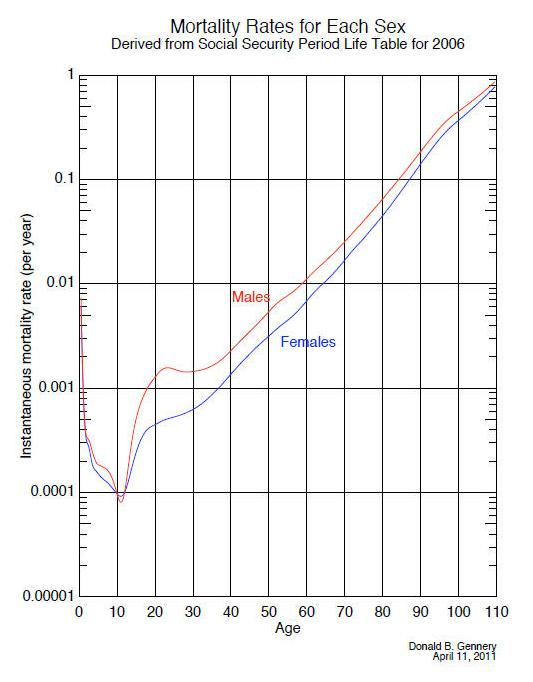
April 12, 2011; Donald
B. Gennery, our GRG Biostatistician from JPL, has provided us with a US snapshot comparing
genders throughout our full life history, starting at birth and going all the way to age 110 years
(for the latest year for which data are available [2006]). Therefore, this graph helps to explain the
basis for the puzzling dramatic worldwide female longevity advantage amongst
Supercentenarians (F:M > ~10:1).
Editorial: Note the curious discrepancy between males and females between ages 20
and 30 in which male mortality appears to plateau while this phenotypic leveling-off is
not so conspicuous for females who encounter the risk of childbirth during this decade of their
maximum fertility. Some part of the human genome seems to be busy calibrating (or fine tuning)
the absolute numbers of males and females to become comparable at age ~20, so that, in
principle, everyone has a partner/spouse, but how this might be done at the genetic level is not
known. One could explain this phenotype by means of genes that manipulate the endocrine
system (Testosterone:Estrogen ratio and monthly clocks in the pituitary gland) for each gender,
but that wouldn't help us extend longevity by Hormone Replacement Therapy (HRT) during the
extended grandparenting interval of menopause/andropause in which all sex-related hormones
"flat line" and the addition of bio-identical estrogen after age 70 for women appears to be
counterproductive (actually increases mortality) according to the latest data published in
JAMA. So it seems that "demography is destiny."
January 19, 2010; Donald B. Gennery of JPL, and our GRG Biostatistician, has provided us
with a White Paper entitled, Mortality Rate as a
Function of Age
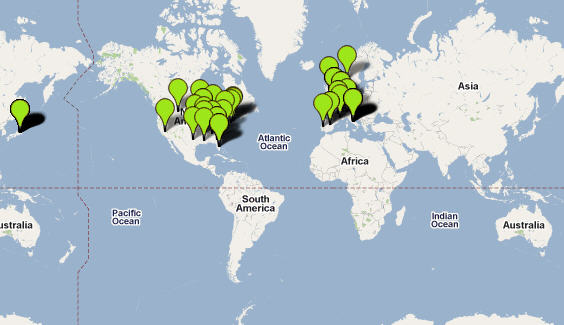
January 28, 2010; The worldwide geographical distribution of Supercentenarians, according
to their current residence, as of today's date, is shown as follows...
thanks to the efforts of Amr Saad. Note: The pattern is conspicuously skewed by the unavailability of accurate birth
record keeping in most countries in the Southern hemisphere back in the late 1800's. This is
likely to change in the next few years, so we can expect to see a better representation from below
the Equator, not because Supercentenarians are not there, but because we can start to validate
them for the first time.
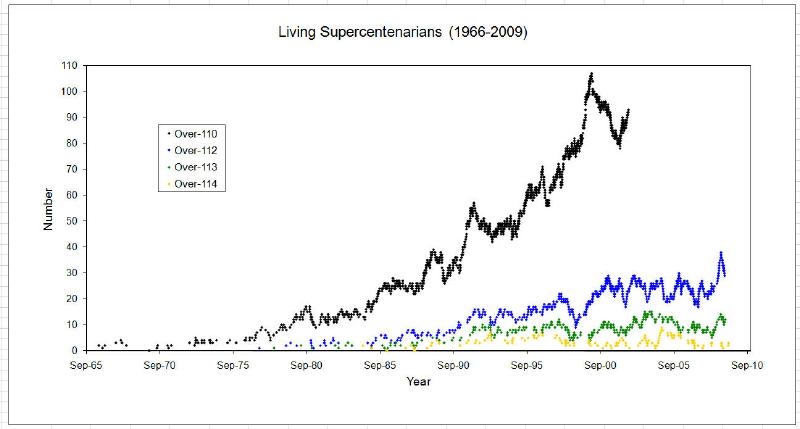
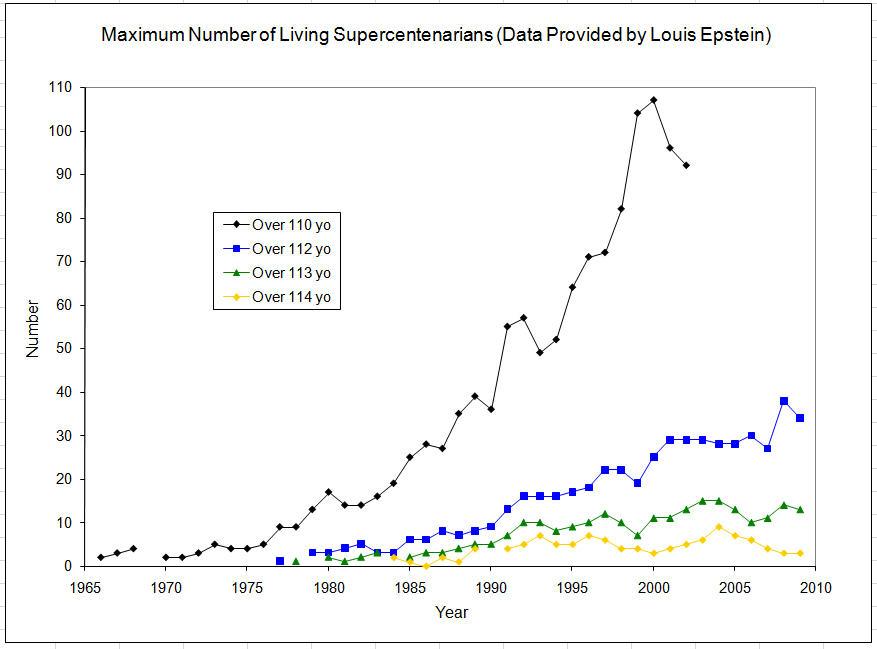
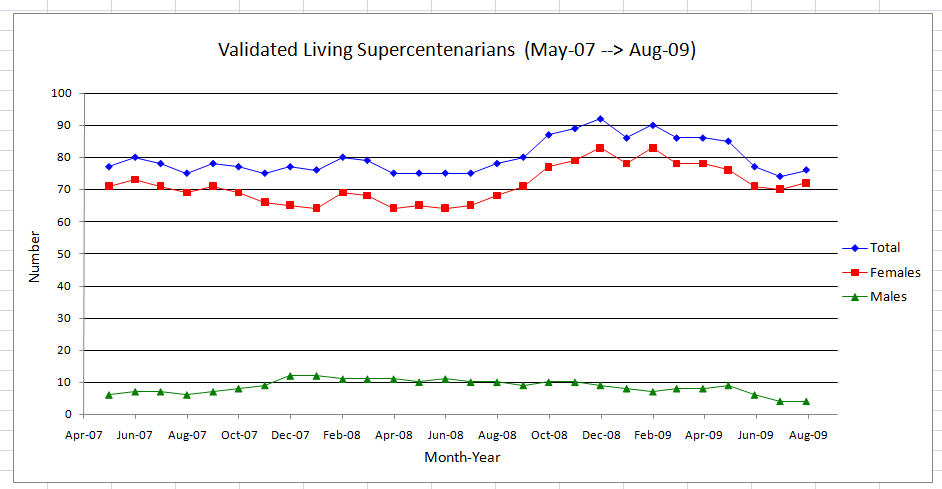
September 9, 2009; Here is a newer graph of the Numbers of Validated Living
Supercentenarians from 1966 to 2009 for 110, 112, 113, and 114 yo's, provided by Afrim Alimeti
of Lowell, MA based on source data provided by Louis Epstein of New York. The first graph is
at high resolution while the second graph shows one point per year...
The first and
second graphs show yearly data points on the numbers of Supercentenarians over this time period
for which we have data. The third graph plots 28 data points on a monthly basis from May 2007
to August 2009. One now more clearly observes the counterintuitive conclusion that the total
numbers of living Supercentenarians have not continued to rise as one might expect based on the
exponentially rising numbers of centenarians over the same time period, but somehow have
become "flat." How could that be?
For the third graph, the upper line (blue) is the total number, while the next line (red) is for
females, and the bottom line (green) is for men; the enormous gap between these latter lines (red
minus green) is a complicated story to be discussed at a future time.
The points
in the third graph cannot simply be pasted into the first or second graph at this time, since there
are incompatible artifacts in the way the second-graph's data was compiled, which are not present
in the earlier data. For example, these data do not include retrospective posthumously-identified
cases. There are also problems associated with the fact that some of cases were not first
identified until they were 111, 112, or older and since they were also alive at their earlier ages,
the different age categories would have to be modified to incorporate the new data. Data from
the second graph were a snapshot of the current level at the end of each month and not in the
middle of the month. Finally, for the most recent month in 2009, it neglects cases that could
have been added from the current pipeline of new cases waiting to be processed, but not yet
entered for administrative reasons. We hope to produce a more uniform higher-resolution graph
(without a gap in the time axis) for publication in the near future.
We will
also have a detailed set of hypotheses for the trends we observe. One hypothesis is that trends in
total numbers of living Supercentenarians will continue to rise indefinitely along with average
life expectancies where any local statistical fluctuations in a particular year can be interpreted as
due to chance. On the other hand, a second hypothesis could be that we are witnessing the
emergence of a biological limit to the expression of the maximum potential human lifespan
inherent in our species' genome regardless of the life-style choices made by individuals or the
locations in which they live. The hypothesis that there exist longevity hotspots has been
pretty-much discredited. It could be that we will never see anyone exceed Madam Jeanne
Calment's Guinness Book of World Records record of 122 years 164 days in the
next twenty-five years, unless, of course, biological engineers learn how to manipulate the rate of
aging itself, in which case "all bets are off."
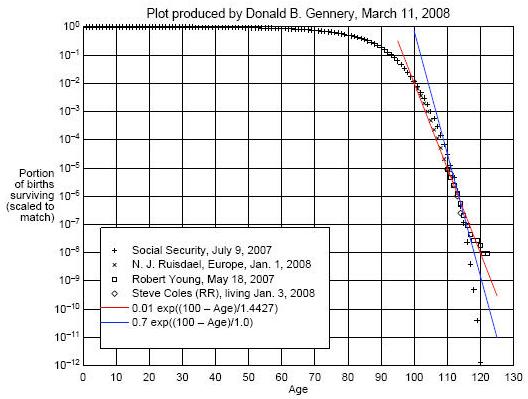
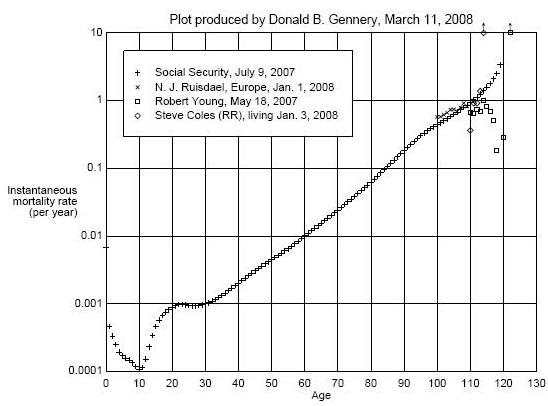
March 13, 2009; Here is a newer
graph prepared by Donald B. Gennery of Social Security Data with a manual fit to Ruisdael's and
Robert Young's data, spliced together at age 90 yo. The ambiguity in the five dots after age 115
lies in the small number of data points available needed to get a smoother curve. - - Steve
Coles
Don adds...
Notice that it shows the mortality rate to be decreasing above about age 110, although this might
not be statistically significant. The dots indicate the one-sigma limits of a straight-line fit (on the
logarithmic plot) to Robert Young's data above age 111 (which is what the curve at those high
ages mostly depends on). They might represent an overestimate of the uncertainty (because they
do not include the influence of any data at younger ages), or they might represent an
underestimate of the uncertainty (because they do not include the possibility of curvature at these
high ages). You could briefly describe the dots by saying that they roughly represent the
uncertainty due to the sparseness of the data at high ages. - - Don Gennery
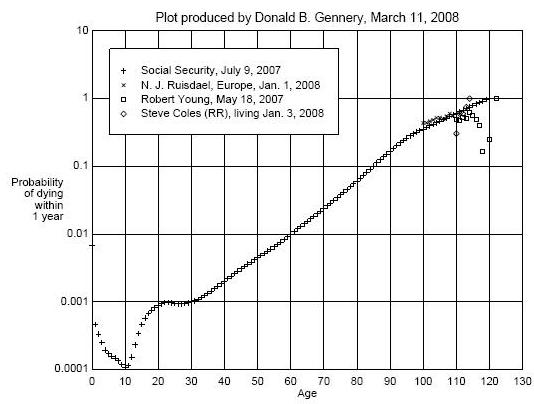
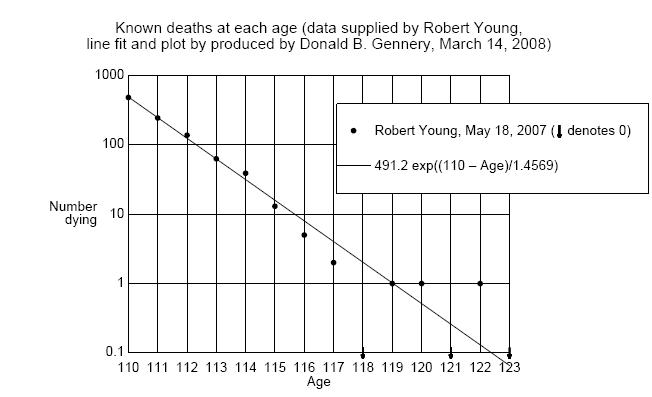
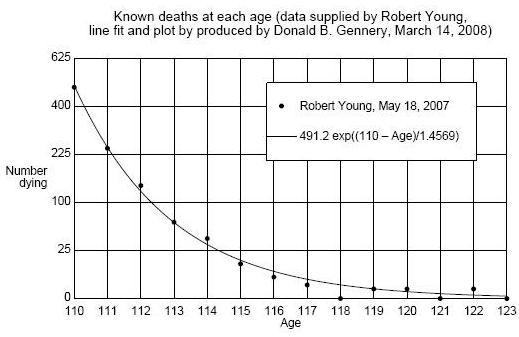
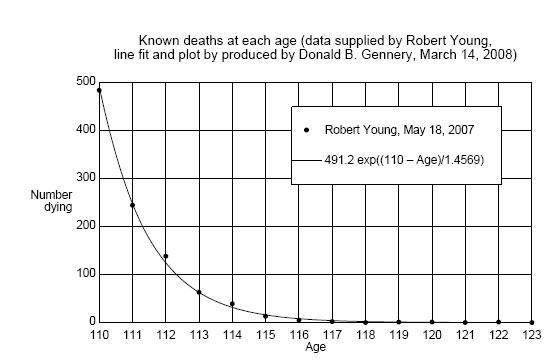
March 19, 2008; Here are six charts prepared by Donald B. Gennery on March 11th and March
14th. During the last week there has been considerable dispute by GRG members in our
Discussion Group as to why three consecutive points fall below the Linear Regression Line in the
fourth chart. The primary mathematical interpretation says that these points being below the line
is simply "due to chance." This explanation can not be ruled out because there is not sufficient
statistical power in such a small population to claim otherwise; but the interpretation that there is
some real, underlying genetically-based pathology (what has been called a fuzzy barrier
that could explain it) is still worth being pursued. It may actually be a real phenomenon, but it
might not. If so, there could be a peculiar genetic predisposition to kill off Supercentenarians
starting at age 114 and ending at age 117 such that we should look for it in their DNA sequence
(for example, a SNP in the TTR-gene that causes amyloidosis or telomere shortening leading to
Uusual Interstitial Pneumonia) vs. those who escape through to age 119 (three persons so far) as
a control group. But this hypothesis has no consensus yet. More will be posted about this debate
later on as time goes on. - - Steve Coles
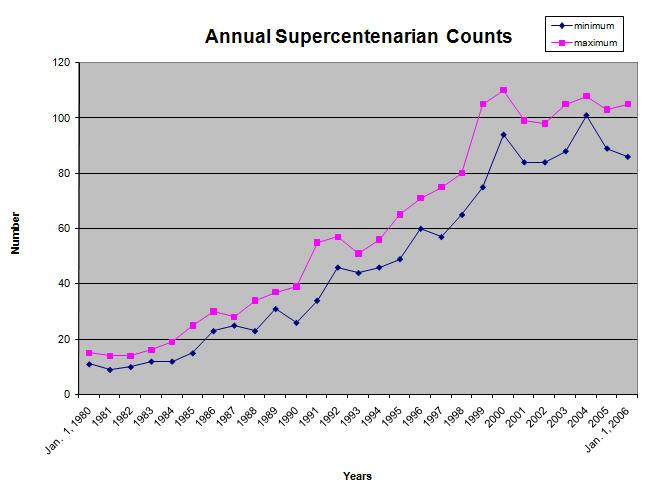
May 25, 2007; An important statistical question about the demography of Supercentenarians is
whether their net numbers are increasing exponentially over time (synchronized, say, with the
observed rise in the numbers of centenarians) or whether their numbers have remained relatively
flat (with a small positive linear slope). Now, Mr. Robert Young, GRG Senior Claims
Investigator of Atlanta, GA, and Miguel Quesada have graphed the numbers of
Supercentenarians over the last 25 years between [1980 and 2006] to reveal the presence of any
obvious trends above. They conclude: "We observe a steady rise from [1980 to 2000] followed
by a modest leveling off since the turn of the century. However, missing cases, which are
discovered subsequently, can bias these trends. Given that most of the missing cases are from
2000 onward, we speculate that the rise is continuing, albeit at a slower rate. However, we see
that, theoretically, Table E, on this website, could easily have been over 100 cases if we could
only validate every potential case at the same time. Yet, we notice that the greatest age -- 114 --
remains the same. Thus, we can conclude that most of the missing cases are for age range [110 -
111] yo."
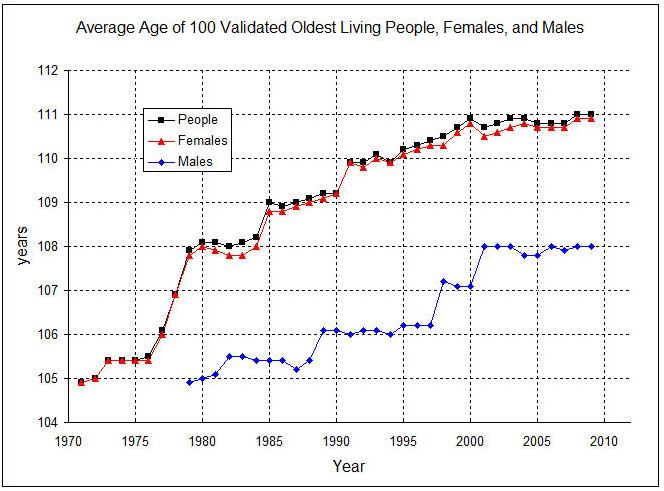
January 24, 2010; Mr. Afrim Alimeti has sent us this Graph of the Average Age of the
Validated Oldest Living Persons by Gender covering the years [1971 - 2009]. Note that these
average ages have remained relatively flat starting from the year 2000 to the present day. The
Female advantage of approximately three years is also conspicuous on the graph. Independently
on Table E, we see that there are approximately eight times as many Female
Supercentenarians as Males, and this discrepancy has not been explained based on what we now
know about our observed human longevity phenotype.
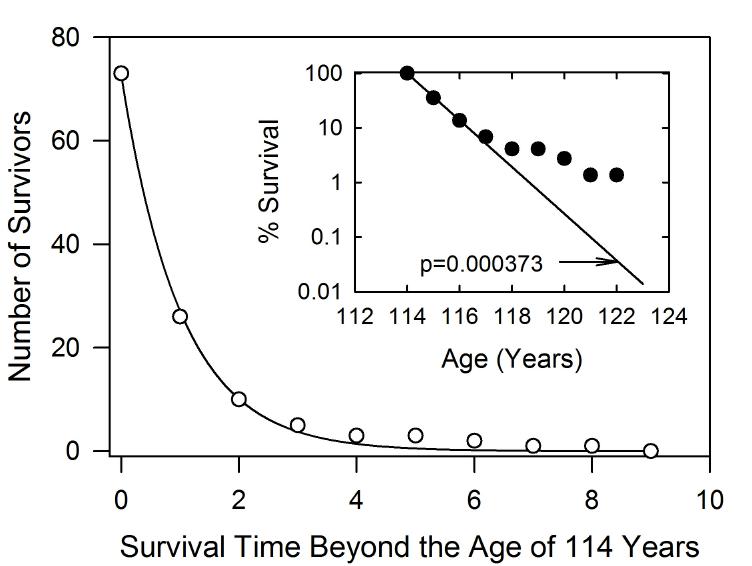
January 20, 2010; Dr.
Greg Fahy has provided us with the following graphs of Supercentenarians 114 yo and above and
110 yo and above.
From a quick
inspection of the first Graph, the seductive conclusion is that "human mortality flattens or
plateaus at age 114 (and thus aging has been halted!). However, there is no consensus for this
conclusion among the members of our GRG Discussion Group given that there are so very few
points in this category to provide statistical significance. The real question is... Do these cases
represent a statistical aberration (red herrings) or is there a biological basis in the human genome
for these outliers not dying on a standard life-history schedule as they mathematically should?
As a corollary, if there is a biological basis for this plateau, "Can the phenotype of aging can be
conquered for ordinary people by finding out what these longevity-determining genes are and
later figuring out how to manipulate them by genetic engineering?" - - Steve Coles
Dr.
Fahy further says, "Both curves are based on the assumption of a constant mortality rate above a
certain age. The data for survival from the age of 110 on indicate that the expected number of
122 year olds at any given time is equal to the number of 110 year-olds times 0.00038, or roughly
1/4, which amounts to roughly one 122-year-old every 4 years. The data for survival from the age
of 114 indicate a much lower expectation of finding a 122-year-old because the size of the
114-year-old population is much smaller and the mortality rates of [114 - 116] year-olds is higher
than expected from the trends from age 110 onward. Since the observed number of people aged
118 and over is so consistently above the projection obtained from the 114-year-old starting
point, and since the curve fit from 110 onward accommodates both the [114 - 117] and the [118 -
122] age groups equally well, it seems likely that the higher mortality rate for [114 - 116] year-
olds is just a statistical fluke, and that the true human mortality rate is really a constant from the
age of 110 onward. What is not possible is that human mortality continues to increase
exponentially from the age of 30 until the maximum lifespan is reached, as predicted by the
Gompertz equation. The existence of a late-life mortality plateau for humans and other species
implies that aging stops above a certain age. On the other hand, starting the analysis on the basis
of Gompertz mortality continuing from a general trendline starting from the ages of 90 and
below, one would predict that no one would exceed the Calment Limit over less then geological
time periods"
See the News Section for the latest World's Oldest Person, 116 year old Sra.
Maria Esther Capovilla of Guayaquil, Western ECUADOR who was validated by the GRG
and Guinness Book of World Records.
August 27, 2006; We are sad to
report that Maria passed away at 3:00 AM this morning due to pneumonia. More details
later.
Click for the latest US and World Population Clocks from the Department of the Census
(POPClocks). This data is
frequently useful as a denominator in many demographic ratios.
Click
on the cover of the November 2005 issue of National Geographic (on the news stands
now), Vol. 208, No. 5, pp. 2-27, for more details. Then, you can join their Discussion Board to provide your own
comments on the links between lifestyle, genes, and longevity...
Here's an Abstract: What if I told you I could add up to ten years to your healthy lifespan? A long
healthy life is no accident. It begins with good genes, but it also depends on good habits. If you
adopt the right lifestyle, experts say, chances are you may live up to a decade longer. So what's
the formula for success? In recent years researchers have fanned out across the globe to find the
secrets to long life. Funded in part by the U.S. National Institute on Aging [part of NIH],
scientists have focused on several regions where people live significantly longer: (1) In Sardinia,
ITALY, one team of demographers found a hot spot of longevity in mountain villages where men
reach age 100 at an unusual rate; (2) On the islands of Okinawa, JAPAN, another team examined
a group that is among the longest lived on Earth; and (3) in Loma Linda, CA, researchers studied
a group of Seventh-Day Adventists who rank among America's longevity "all-stars."
Residents of these three places produce a high rate of centenarians, suffer a fraction of the
diseases that commonly kill people in other parts of the developed world, and enjoy more healthy
years of life. In sum, they offer three sets of "best practices" to emulate. The rest is up to
you.
"New data indicates that average human life expectancy is likely to reach 100 by the
year 2060." Discover Magazine, pp. 67-8 (January 2003).
Debra Goldschmidt, CNN Medical Unit, "Study: Aging Well Runs in Families,"
CNN (November 18, 2002).
Dr. Dellara Terry, Director of the Genetics of Longevity Study at Boston University Medical
Center, said "Children of persons who have reached 100 years of age are less likely to have
cardiovascular and other chronic diseases." She examined 177 children, one of whose parents
was a centenarian, and who were living independently into their 90's.
Jeff
Israely, "Letter from Sardinia (Italy): Something in the Air: How do the Inhabitants of This Small
Sardinian Town (Orroli) Manage to Live So Long?",
Time Europe (December 9, 2002).
Prof. Luca Deiana, a Researcher at the University of Sassari in Northwest Sardinia, said that he
believes that "his island has the world's highest documented percentage of people who have
passed the 100-year threshold." Part of his support comes from Duke University. They are
focusing on the genetics of the "Y" Chromosome, since "the gender ratio of female:male
centenarians in Sardinia is more like 1:1 as compared with the more typical ratio of 4:1 in the rest
of the world.
[ Editor's Note: The Time article got Mr. Giovanni Frau's ranking wrong; he is
only 20th, not 3rd in the world.]
Two University Professors Form a Wager on "The Maximum Human Life Span" 150
Years from Now
Click for another photo gallery of
Supercentenarians
carefully organized by age and maintained by Mr. Robert Young of Atlanta, Georgia, our GRG
Senior Claims Investigator.
Numbers
of US Centenarians are expected to rise exponentially between now and 2050.
April 11,
2008; The latest Census projection, made in 2003 calls for a US centenarian population of 1.1
million in 2050. That's up from a projection made a few years earlier of 834,000. Click on the
graph for a link to the US Census Bureau report.
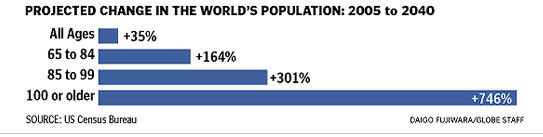
July 24, 2009; From today's The Boston Globe.
Ref.: "Living to
100 May Be Easier Than Counting Those Who've Made It," The Wall Street Journal, p.
B1 (April 11, 2008).
February 7, 2008; February 13, 2010;
Assuming that there are 300 million U.S. Citizens, the chances of someone becoming a
centenarian is 1:80 [*](there are ~80,000 US centenarians today); on the other hand, the chances
of someone becoming a
Supercentenarian is only 1:50,000. [*]
Three orders of magnitude represents a huge difference for just one decade! Prof. Tom
Perls, M.D. of The New England Centenarian Study in Boston, MA has recently
stated that the likelihood of becoming a Supercentenarian was 1 in 7 million [**], but this
calculation most likely refers to the present world population and not the population at the
time of birth.
________________________ *: These revised estimates of the rate of centenarian and Superercentenarian survivors
are based on Social Security Data supplied by Donald B. Gennery, GRG Biostatistician, in which
we must compare the number of survivors to the number of births during an appropriate span of
time (probably ~2 years) either 100 years ago (c. 1910) or 110 years ago (c. 1900), for their
respective cohorts. **: Sarah Baldauf, "The Science of Aging: Our Genes, Not the Whole Story:
Epigenetics Is
Exploring Why Our DNA Is Not Necessarily Our Destiny," US News & World Report,
Vol. 147,
No. 2, p. 29, col. 2, Lines 4,5 (February 2010).
Click for a table of 39 famous classical Greek Philosophers
and Statesmen who are known to have survived past the age of 70, at least some of whom
did go on to become Centenarians. Therefore, I would speculate that the density of Centenarians
per capita may well have been the same in (civilized) ancient times as it is today. It's just that
there has never been any good documentation for ordinary people who were not already famous
for some reason or another, so all the demographics are biased in favor of wealthy or powerful
individuals rather than the ordinary person. Grmek and Gourevitch speculate that during the
Classical Greek Period, anyone who made it past the age of 5 years -- surviving all the common
childhood illness of that day -- had a reasonable chance of living to a ripe old age. [Life
expectancy at 400 B.C. was estimated to be around 30 years of age.] One demographer of
ancient civilizations reported that Greek men lived to 45 years (based on a sample size of 91),
while women lived to 36.2 years (based on a sample size of 55). Curiously, the gender statistics
are inverted compared to today, since child-birth was a much more traumatic experience at that
time than now, and it certainly skewed female statistics downward. Also recall that it was
common for average citizens to take great care in their hygiene (sanitation), Mediterranean diet
(fish, figs, olive oil, wine, etc.), and exercise program (sports/gymnasium), although I suspect
that there was a lot more male trauma per capita than today and that biased the statistics for men
downward. [Ref. Mirko Grmek and Danielle Gourevitch, Illness in Antiquity (Fayard;
1998).]
The "bottom line" is that there is no reason to believe that there couldn't have been a lot of
men/women in a population of 2,500 years ago who were Centenarians, even if they weren't
commonplace. [Source for Table: Olivier Postel-Vinay, "Histoire Le Cas de la Grece Antique,"
La Recherche Special -- Vivre 120 Ans, Vol. 322, p. 90 (Paris; July-August 1999). Note:
La Recherche is the French equivalent of Scientific American in the
English-speaking world.]
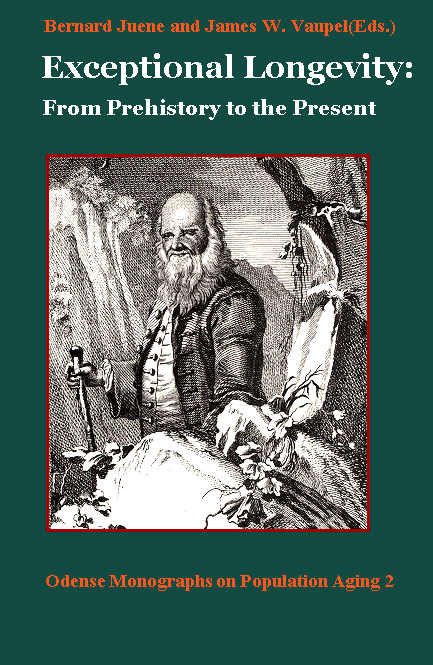
A 1995
Monograph on Exceptional Longevity: From Prehistory to the Present, Vol. 2, Edited by
Bernard Jeune, M.D. and James W. Vaupel, Ph.D. in the Odense University Press Series on
Population Aging is an excellent source for more details and is now available free of charge
on the Internet. Click on the book cover above... The general series of Odense Monographs on Population Aging, (Max
Planck Institute for Demographic Research, Rostock, Germany; 1995) is an excellent resource
for the field.
Other historical sources for claims of extreme longevity can be found in the following two
books:
1. James Easton, Human Longevity: Recording of Name, Age, Place of Residence, and Year
of the Decease of 1712 Persons Who Attained a Century and Upwards from AD 66 to 1799,
Comprising a Period of 1733 Years with Anecdotes of the Most Remarkable (London; UK;
1799).
Easton collected 427 anecdotes of venerable centenarians throughout human history from Roman
to modern times in an uncritical manner. Most of these will not pass muster as rigorous
verification methodologies were never in place in those years and they follow in the mythological
traditions of high-altitude Shangri-La villages like Vilcabamba, ECUADOR, The Hunza, INDIA,
and The Caucasus, RUSSIA, all of which have been discredited.
2. William J.
Thoms, The Longevity of Man, Its Facts and Its Fictions (J. Murray, London; UK;
1873).
Thoms, the Deputy Librarian for The House of Lords, focused on royalty and
aristocracy, whose births and deaths were recorded long before birth registration became
universal in the 19th-Century. Sadly, Thoms did not find a single instance of a Peer, Duke, or
Baron who lived to be a centenarian.
The Huffington Center on Aging at the Baylor College
of Medicine in Houston is another interesting source for information about Centenarians.
As reported on the font cover of USA Today (August 24, 1999), The U.S. Census
Bureau forecasts that the number of Americans age 100 or older will increase by more than 22
times the 1990 estimate of 37,306. In October 2001, the US Census Bureau actually
reported that there were 50,454 US Centenarians (a more reasonable 35 percent increase) out of a
total population of 281.4 million Americans. But by 2050, "the number of US centenarians is
expected to reach 834,000 and maybe even 1 million," said Dr. Robert Butler, President of the
International Longevity Center in New York City.
From present data, the number of worldwide Centenarians is around 450,000. However, if
one considers only the total number of Supercentenarians (by definition, persons
surviving to >= 110 years) this number falls dramatically to around 30 worldwide (See details
below). To our knowledge, there are no living persons older than 120; despite the fact that there
are a large number of pretenders from foreign countries, these claimants have never been
rigorously validated by means of the sort of documentation that would be sufficient to prove their
claim (Birth Certificates, Baptismal Certificates, Marriage Certificates, and so forth). But also,
recall that the art of "record keeping" was never rigorous before the age of data processing.
Persons born at home in rural areas were frequently lucky if they had a family Bible to record the
event let alone the correct spelling of the parents names, their ages at the time, etc.
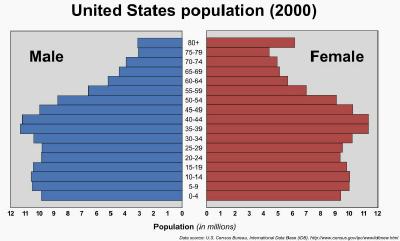
Other highlights form the 2000 Census Report include the following:
1. The
most populous state in the nation, California, has the largest number of centenarian residents,
5,341 or 0.016 percent of its population;
2. The state with the largest percentage of centenarians is South Dakota, where 0.0033 percent of
residents were 100 or over. South Dakota was followed by Iowa and the District of Columbia;
3. Of the five-year age groups, the [50-to-54] category had the largest increase, up 55 percent to
17.6 million, thanks to the "Baby Boomers";
4. While women still outnumber men at older ages, the gender ratio in the [65-and-over]
category
increased from 67 men per 100 women in 1990 to 70 men per 100 women in 2000.
An excellent book covering the topic of Centenarians is Lynn Peters Adler,
Centenarians: The Bonus Years (Health Press; Santa Fe, New Mexico; 1997). Lynn
maintains a website at the National
Centenarian
Awareness Project at 3135 East Marshall Avenue; Phoenix, AZ 85016.
November 10, 2005; Another interesting photographic book devoted to Supercentenarians is
Jerry Friedman's book Earth's Elders: The Wisdom of the World's Oldest People (
ISBN: 0976910802; 215 pages; Earths Elders Foundation; 2005; $19.77 on
Amazon.com).
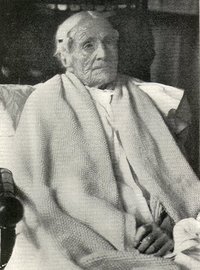
Supercentenarian Ann Pouder [April 8, 1807 - July 10, 1917] photographed on her
110th birthday.
March 27, 2010; For the mathematically inclined, who are interested in numbers, consider
spending some time on either of the following two websites:
1. Representing Large Numbers is from
Louis Epstein of New York, while
2. Nature by
Numbers is a YouTube video clip from filmmaker Cristóbal Villa and
Eterea Studios with some very pretty graphics. (TRT = 3:44 min.)
This is the end of the Supercentenarian file.
Click to continue to File No. 2 of 15.